
Operations | Monitoring | ITSM | DevOps | Cloud

The latest News and Information on Incident Management, On-Call, Incident Response and related technologies.

Automation in MSPs: Streamlining Service Delivery and Boosting Profitability

In today’s complex IT environment, clients demand quick, reliable services. To accomplish this, businesses have begun leveraging automation solutions to reduce response times and increase reliability, enabling staff to focus on strategic initiatives that drive business growth. However, many MSPs struggle to build an effective automation strategy and need help, making it challenging to remain competitive in the modern marketplace.


Augmenting MSP Helpdesk Support: 5 Workflows

Managed Service Providers (MSPs) are the backbone for many businesses, ensuring that IT systems run smoothly and efficiently. They offer a cost-effective alternative to building an in-house tech team, often allowing companies to leverage cutting edge expertise without the significant expense and responsibility associated with expanding headcount.

Mastering the Sev0

Remind yourself of the worst incident your organization has faced. If you’re lucky it might have been your entire service being offline for a period of time. Less lucky, and perhaps you encountered something affecting the sensitive data your organization is the custodian of. Whilst uncommon, incidents of this severity happen to every organization at some point. This criticality of situation is what many refer to as a Sev0, the most severe of incidents.

Six key capabilities of an AIOps platform

Unplanned downtime can cost large enterprises almost $1.5 million per hour, according to a recent survey by Enterprise Management Associates. AIOps offers a solution. With an effective AIOps platform in place, you can decrease the frequency and cost of outages by 30% and reduce their duration to under an hour. AIOps platforms apply AI and machine learning to complex IT data to enhance and automate IT operations.

The Benefits of a Single Incident Management System

How many monitoring tools do you have? Chances are at least 2-3. One tool usually does not cover all cases, and it’s usually a combination of self-managed and managed tools. Self-managed gives you more control over custom configurations and cost. Managed ones take away the headache of running it yourself. Prometheus is the de-facto standard for monitoring these days if you have a modern application stack and you want to manage your own monitoring.

On-call scheduling to streamline incident response systems in high-velocity teams

Murphy's Law says that "Anything that can go wrong will go wrong," drawing attention to the inevitabilities of life laced with irony. In IT monitoring, we can tweak it and say, "The most important monitoring alert will always trigger when you're on vacation with spotty internet." Given life's uncertainties, how can IT engineers stay prepared at all times? Especially when we know that all it takes is just one person staying alert and available when things go wrong in IT to tide over outages.

Incident Response for Critical APIs

Incident response is a structured approach to addressing and managing the aftermath of a security breach or cyberattack, also referred to as an IT incident, computer incident, or security incident. The goal is to handle the situation in a way that limits damage and reduces recovery time and costs. Additionally, it aims to improve strategies and solutions to prevent future security incidents.

How Team Permissions work in OneUptime?

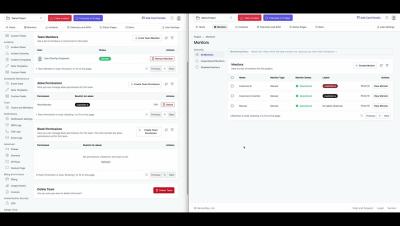
Welcome to our tutorial on Team Permissions in OneUptime! In this video, we’ll guide you through the process of managing permissions for your OneUptime team. OneUptime offers a comprehensive solution for monitoring and managing your online services. A crucial part of this management is understanding and effectively using Team Permissions. If you do not have permissions to make a request, a 4xx status will be sent as a response.

Don't take a cookie cutter approach to incident management with Toby Jackson

This week, we have a really fun conversation lined up. For this episode, we chatted with Toby Jackson, Global SRE Team Lead at Future, about why it’s a bad idea to take a cookie-cutter approach to incident management or, put another way, why it’s not a good idea to treat all incidents alike. In our conversation, we discuss what’s wrong with this approach, some situations where this might actually make sense, how psychological safety factors into this conversation, and a whole lot more.