Operations | Monitoring | ITSM | DevOps | Cloud

The latest News and Information on Continuous Integration and Development, and related technologies.

Merge Queues for Bitbucket Cloud, now in open beta

Teams are shipping more code, faster than ever, as they increasingly automate their processes with CI/CD and AI. But high-velocity pull-request workflows and large monorepos, where many PRs are merged continuously, are feeling the pain as they grow: pull requests race to merge before the branch changes again, “green” builds still break due to semantic merge conflicts, and developers are stuck babysitting merges instead of building features.

Introducing Agentic Pipelines: AI automation for chores devs don't want to do

Bitbucket Pipelines has always been an engine for automating more than just CI/CD, but today, Pipelines takes a first step towards a full agentic automation platform for all the manual, tedious, repetitive work that happens before and after code creation. You’ve probably seen the stat: Development teams spend 84% of their day doing things other than building features. A lot of this work is: This work matters, but it’s not very fun.

Building an agentic content production system with Claude Code

This post by an engineer explains how his team uses the.claude folder in Claude Code. The folder is the hidden directory where you store context files, behavioral rules, and automated workflows so Claude understands how to operate in a specific project. He’d set up coding conventions, tool configs, CI integrations. Very engineering-brained. The tool is called Claude Code, so fair enough. I run a web and content team. We write blog posts, tutorials, and technical guides for a living.

Scaling Technical Research: Integrating Proxies into Your Data Operations (DataOps) Pipeline

In the world of Big Data, success depends on more than just algorithms. The quality of the incoming data stream is crucial. When a company scales its technical research, it inevitably encounters barriers such as CAPTCHAs, geoblocks, and anti-fraud systems.

Without RBAC for Agent Skills and MCP, your entire organization basically has root access to your company

Let me paint a picture. Your company has rolled out Claude or ChatGPT as the standard AI tool. You've connected MCPs to Stripe, your HRIS, Datadog, your CRM, and Slack. A senior engineer set this up because they needed to answer hard cross-system questions and it works beautifully. Now a marketing intern sits down, opens the same LLM harness with the same MCP config, and types "show me revenue by customer for the last 12 months." They get it.

(AusBiz) JFrog teams up with Nvidia to manage AI agents

AI agents are making real-time decisions inside enterprises right now; pulling code, accessing tools, executing tasks. But most businesses have zero visibility into what those agents are actually using. In this interview on @ausbizTV, Sunny Rao, SVP APAC at JFrog, explains why the governance gap is one of the biggest risks facing enterprises today; and how JFrog and NVIDIA are building the trust layer to fix it.

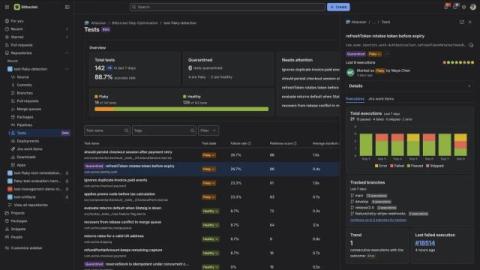
OpenTelemetry Trace Testing for CI Release Gates

OpenTelemetry is great at answering one question: “what just broke?” The problem is that most teams need a different answer first: “what is about to break in this release?” That is where trace-based testing comes in, especially for teams running a vendor-neutral OTel stack (Collector + Tempo/Jaeger + Prometheus) and needing deterministic release gates.

SAS Enhances Security and Compliance with the JFrog Platform

This video features Brett Smith, a distinguished software developer at SAS Institute, discussing how the company secures its software production pipelines for its flagship AI and machine learning platform, SAS Viya 4. SAS initially utilized JFrog Artifactory for managing Java-based Maven and Ivy artifacts. To address the increasing need for robust security and compliance with global regulations, the company expanded its partnership with JFrog by integrating additional security tools to protect their delivery pipelines.

7 AI productivity lessons from the CTO of Superhuman

Most companies have built AI into their product by now, and many consider it the central feature of what they’re building. But plenty of those same companies are still figuring out how to get their own engineering teams to actually use AI tools day to day. When Loïc Houssier joined Superhuman as CTO in early 2025, his team was in that exact spot. The company had been shipping AI email features for years, but internal adoption of AI dev tools was still early.