Operations | Monitoring | ITSM | DevOps | Cloud

Latest posts

Tigera: Hands-on workshop: Learn best practices to address enterprise security and compliance challenges in Kubernetes

In this enterprise compliance focussed workshop for Kubernetes, you will work with a Calico subject matter expert to learn how to design, deploy, and observe security and networking policies to ensure compliance in your Kubernetes environment. This 90-minute hands-on lab with your own provisioned Calico Cloud environment is designed to provide more complete knowledge on how to implement.

Tigera: Meeting SOC 2 compliance and audit requirements in SaaS and cloud environments

SOC 2 compliance is a component of the American Institute of CPAs (AICPA)'s Service Organization Control reporting platform, whose goal is to ensure that systems are enabled to support the five trust service principles: security, availability, processing integrity, confidentiality, and privacy of customer data. The SOC 2 auditing procedure is specifically designed for service providers storing customer data in the cloud. That means SOC 2 applies to nearly every SaaS company, as well as any organization that uses the cloud to store its customers' information. For security-conscious businesses handling sensitive customer data, SOC 2 compliance is a minimal requirement when considering a SaaS provider.

How Does a Digital Experience Score Optimize the Workplace

User experience is subjective. For example, asking tourists visiting New York City about their experiences gives different answers. Likewise, end-users who work remotely with different resources and disparate assets can have varied experiences with their business applications. How can IT teams gather this experience data and react faster to improve experience? The answer is Digital Experience Scores.

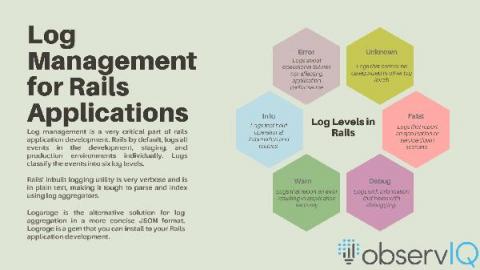
Rails + observIQ; Chapter 1: Log management at the core of Rails application development

Logging is useful in building, managing and debugging Rails applications. Most logging functionalities are built into the application, and it is fairly simple to find the logs. However, as your applications scale up in volume, it becomes difficult to trace the source of an issue. That’s when you want to implement a cloud based log management system to get a unified view of all logs from your Rails application.