Operations | Monitoring | ITSM | DevOps | Cloud

Why Use a Status Page Aggregator?

Managing multiple vendor dependencies has become a critical challenge for modern businesses. When your operations rely on dozens of third-party services, tracking their status individually becomes inefficient and risky. A status page aggregator solves this problem by consolidating all vendor status information into a single dashboard.
How to Choose the Best Vendor Monitoring Platform for Your Team

Modern businesses rely on dozens of third-party services to operate effectively. When AWS goes down, your application might crash. When Stripe has issues, payments fail. When Slack experiences an outage, team communication grinds to a halt. Vendor monitoring platforms help you track the health of these critical dependencies before they impact your operations. But with numerous options available, selecting the right platform requires careful evaluation of your team's specific needs and workflows.

The Case for Intelligent Automation in Network Operations

In the last decade or so, network infrastructure has undergone a massive transformation. With the rise of hybrid cloud, distributed applications, and software-defined everything, managing networks has become exponentially more complex. What used to be a stable, predictable environment is now a constantly evolving system of interconnected services, protocols, and devices, each with its own telemetry, APIs, and failure models.

How to monitor your Laravel app for critical vulnerabilities using Oh Dear

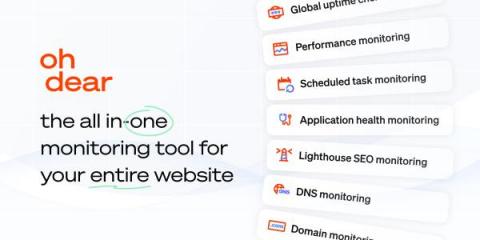
A critical security vulnerability was recently discovered in Livewire v3 that allows remote code execution, as Stephen Rees-Carter reported on Securing Laravel. While patches are released quickly, many applications remain vulnerable because developers simply don't know about the issue yet. Oh Dear's Application Health monitoring solves this by continuously checking your production environment for security vulnerabilities and immediately notifying you when issues are detected.

Cloud or Self-Hosted - Which Deployment Model is Right For You?

Choosing the right observability platform is a critical decision. But how you deploy it is just as important. The right deployment strategy can accelerate your team, simplify operations, and ensure you meet compliance and security requirements. The wrong one can lead to operational headaches and slow you down. At SigNoz, we believe in flexibility. There is no single "best" way to deploy an observability platform; there's only the way that's best for you.

I built an MCP Server for Observability. This is my Unhyped Take

Recently, I read a blog titled “It’s The End Of Observability As We Know It (And I Feel Fine)”, which discussed MCP servers in observability and how these systems would potentially be the “end of observability”. As someone who has spun up an MCP server for an observability backend and as someone who has been in the space for a while, I certainly do not think so.

Stream AWS Metrics to Grafana with Last9 in 10 minutes

It’s 2:47 AM and your Lambda functions are timing out. API response times are spiking. You’re flipping between the CloudWatch console, your APM tool, and your logs, trying to figure out what’s going wrong. CloudWatch has the metrics you need: CPU usage, memory pressure, and request rates — but connecting that data to what your app is doing takes time. The delay in stitching it all together slows down your incident response.

Set Up ClickHouse with Docker Compose

ClickHouse is built for high-performance OLAP workloads, capable of scanning billions of rows in seconds. If your analytical queries are bottlenecked on PostgreSQL or MySQL, or you're burning too much on Elasticsearch infrastructure, ClickHouse offers a faster and more cost-efficient alternative. This blog walks through setting up ClickHouse locally with Docker Compose and scaling toward a production-grade cluster with monitoring in place.