Operations | Monitoring | ITSM | DevOps | Cloud

Why More Choices Matter With Observability Tools

Observability is a broad topic that provides visibility into the key metrics powering customer-facing applications. These applications range from external facing applications ( e.g., Internet banking/online education/e-commerce/government records ) to internal facing applications ( e.g., Trading systems by brokers, Logistics controllers, Traffic Management, and Hotel Reservations). Observability also incorporates backend systems powering industries that ensure smooth operations of tools and processes.
Application Observability And Its Role In Modern Software Development

Over the last few decades, software systems have grown complex due to the emergence of cloud-native architectures and multi-cloud environments. On the one hand, this makes it difficult to detect issues faster in the deployed application. It also requires intricate coordination between development, DevOps, and SRE teams, as they are also expected to speed up the whole software delivery process.

Devops Best Practices for Observability

Imagine one night you receive a notification from your team member that a critical production problem has caused chaos in your application. There is a sudden drop in sales as customers are unable to access the application and reporting issues relating to the same. Now, when you reach the office to fix the issue, you demand the team to run through all the files.

How to achieve Observability for Microservices-based apps using Distributed Tracing?

Modern digital organizations have rapidly adopted microservices-based architecture for their applications. Microservices-based apps have components designed around business capabilities serving a specific purpose. It enables smaller engineering teams to own specific services that lead to increased productivity. But componentization also leads to complexity. Today’s modern internet-scale businesses have hundreds or thousands of microservices.

Elastic Observability 8.14: New feature for SLO, AI Assistant, and .NET for Universal Profiling

Elastic Observability 8.14 announces the general availability (GA) of key Service Level Objective (SLO) management capabilities, additional enhancements to the Elastic AI Assistant for Observability, alerting improvements, and Universal Profiling for.NET. Enhanced SLO management capabilities: Enhanced AI Assistant capabilities.

Native and eBPF-based Kubernetes Workload Profiling for Kubernetes Clusters

System observability is an essential part of identifying performance issues within your environment because it provides a comprehensive view of how your systems are operating at a glance. Typically, observability is achieved through the collection and analysis of metrics. These metrics, generated by your applications, are deliberately incorporated by developers into the source code to offer insights into the application’s internal processes.

Bringing ArchiMate Flow Diagrams to Life with End-to-End Observability

Aligning IT infrastructure with business processes is paramount in today's digital landscape. This article explores how organizations can elevate their architectural modeling by integrating ArchiMate's flow diagrams, which are initially manually created, with the dynamic, auto-discovered components from StackState's end-to-end observability.

Logz.io Upgrades App 360, Kubernetes 360 with AI Assistant, New Tracing Quickview

At Logz.io, we believe the future of observability will center on the rapid advancement of automation, innovations around artificial intelligence, and streamlining processes that currently remain far too complex. This is no different than many other areas of technology, but the opportunities in observability are vast, and we see all of these areas connecting and driving improvements to the Logz.io Open 360 platform.

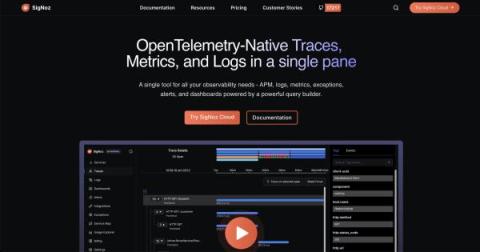
Deep dive into observability of Messaging Queues with OpenTelemetry

Working in the observability and monitoring space for the last few years, we have had multiple users complain about the lack of detailed monitoring for messaging queues and Kafka in particular. Especially with the coming of instrumentation standards like OpenTelemetry, we thought there must a better way to solve this. We dived deeper into the problem and were trying to understand what better can be done here to make understanding and remediating issues in messaging systems much easier.

Network observability in Kubernetes clusters for better security and faster troubleshooting

For DevOps and platform teams working with containers and Kubernetes, reducing downtime and improving security posture is crucial. A clear understanding of network topology, service interactions, and workload dependencies is required in cloud-native applications. This is essential for securing and optimizing the Kubernetes deployment and minimizing response time in the event of failure.