Operations | Monitoring | ITSM | DevOps | Cloud

Implementing OpenTelemetry in a Gin application

OpenTelemetry can be used to trace Gin applications for performance issues and bugs. OpenTelemetry is an open-source project under the Cloud Native Computing Foundation (CNCF) that aims to standardize the generation and collection of telemetry data like logs, metrics, and traces. Gin is an HTTP web framework written in Go (Golang). It features a Martini-like API with much better performance -- up to 40 times faster. If you need smashing performance, get yourself some Gin!

Simplify managing Grafana Tempo instances in Kubernetes with the Tempo Operator

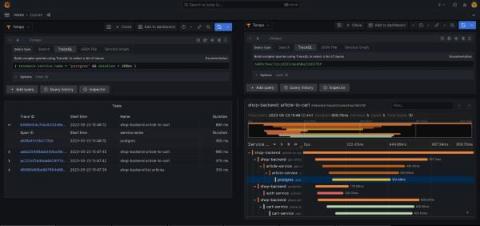
I’ve been working with Grafana Tempo for about half a year now, and one thing I like about it is that Tempo requires only object storage for storing traces, which is easy to set up in both cloud environments and on-premises. Another outstanding feature is TraceQL, which allows searching for relevant traces with a powerful query language.

Harnessing Distributed Tracing for Application Performance Optimization

Distributed tracing is a powerful technique that allows you to track the flow and timing of requests as they navigate through a system. By linking operations and requests between multiple services, distributed tracing provides valuable insights into system performance and helps identify bottlenecks. In this blog post, we will delve into the benefits of distributed tracing, explore its relevance for various application architectures, and uncover how it operates behind the scenes.

Navigating the Serverless Landscape: Lessons from our Tracing Collector API Journey

In the previous blog in this series, we delved into the redesigned architecture of Amazon Prime Video and how they integrated different architectural styles for optimal performance and cost efficiency. We also discussed the impact of Amazon’s decision on the concept of a “serverless-first” mindset, highlighting the importance of considering alternative architectural approaches based on specific use cases and requirements.

Enhancing Observability Through Open Telemetry, industry trends and gaps to be considered

OpenTelemetry is a popular open-source project that provides a standardized way of collecting, processing, and exporting telemetry data from distributed systems. It is designed to be vendor-neutral and supports multiple programming languages and platforms. OpenTelemetry consists of several components that work together to enable telemetry collection and processing.

Understanding APM: How to add extensions to the OpenTelemetry Java Agent

As an SRE, have you ever had a situation where you were working on an application that was written with non-standard frameworks, or you wanted to get some interesting business data from an application (number of orders processed for example) but you didn’t have access to the source code?

OpenMetrics vs OpenTelemetry - How to choose?

OpenMetrics and OpenTelemetry are two popular frameworks that provide metrics-driven insight into complex software environments. Understanding the differences between these two options is critical for organizations looking to optimize their monitoring capabilities. In this article, we will explore the key features, benefits, and considerations of OpenMetrics and OpenTelemetry to help you make an informed decision when choosing the right solution for your organization.

OpenTelemetry vs Prometheus

OpenTelemetry and Prometheus are both powerful observability tools, each with its own strengths. OpenTelemetry provides a standardized way to collect, instrument, and export telemetry data, while Prometheus excels at time-series monitoring and alerting. In this blog post, we will delve into the similarities and differences between OpenTelemetry and Prometheus, exploring the benefits and advantages of each.