Operations | Monitoring | ITSM | DevOps | Cloud

AI cost calculator: estimate your total spend

An AI cost calculator for the whole wallet adds four lanes: seats and subscriptions, API and token usage, cloud AI services, and GPU infrastructure. Average 2026 totals run $25 per employee per month at light adoption, $100 to $150 at active adoption, and $300 or more at AI-heavy companies. Getting to your number takes four lane subtotals and three corrections.

GPT-6 Astra pricing: What OpenAI's new flagship costs in 2026

GPT-6 Astra is OpenAI's flagship reasoning model, released September 3, 2026. It costs $10 per million input tokens and $50 per million output tokens on the standard API tier, with cached input at $1 and cache writes at $12.50. That is 2.5 times GPT-5.6 Sol's promotional rate and matches Anthropic's Fable 5.1 on both headline numbers. Batch and Flex halve those rates, Fast mode doubles them, and any prompt past 272K input tokens reprices the entire request.

How to Cut SIEM Ingest by 90% Without Losing Detection Coverage

Every SOC team knows the trade-off. Send everything to the SIEM platform and pay for it. Or filter aggressively and risk missing something. Filter lists are written once, during onboarding. Detection content keeps moving after that. Smart Engine, the new core of the VirtualMetric DataStream pipeline, takes the guesswork out of that decision. It reduces SIEM ingest using your registered detection rules. An event that no registered detection could match is dropped.

Incident Chat and Virtual War Rooms: How to Improve Incident Response

How do you keep incident communication organized during a critical incident? Effective incident response requires more than getting an alert to the right person. Once responders are engaged, they need a shared place to exchange information, coordinate actions, and track decisions. A dedicated incident chat – or virtual incident war room – keeps that collaboration tied directly to the incident instead of scattering it across email, Microsoft Teams, Slack, text messages, and phone calls.

Live Debugging for Critical Systems: MTBF, MTTR & MTTA

A critical system has to stay reliable without new failures or added downtime, and live debugging, confirming the root cause without stopping the system, is often the only way to do that. In practice, this means having runtime context: on-demand evidence generated at the point of failure rather than logging configured months earlier, which is what keeps MTBF up, MTTR, and MTTA down.

DHCP tells you what was leased. It does not tell you what is answering.

Your DHCP server knows which addresses it assigned. It does not know which of those addresses are answering on the wire right now. That gap shows up in every hybrid network where static devices, reservations, and stale leases sit beside active workloads. Leased and live are different questions. DHCP scopes answer the first. Subnet ping-sweep answers the second. Together they give IPAM fresher last-seen context without handing an NMS credentials across the network.

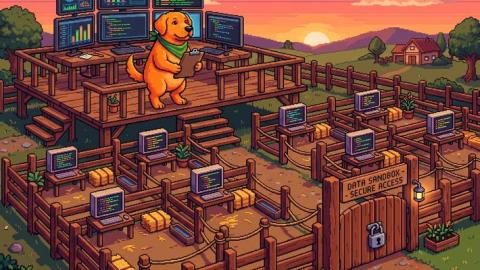
Can we live dangerously? Sandboxing Claude, and the Claude foreman that runs the rest

While logging into one’s LinkedIn will spew out endless talk of AI possibilities from “thought leaders” and the semi-disconnected alike, another pocket of the world spent the last few weeks watching the Shai-Hulud worm chew through npm. A self-propagating credential stealer that hit 400-plus packages and, delightfully, planted Claude Code and VS Code hooks so just opening the repo could run its payload.

Prompts, skills, and the AGENTS.md nobody wants to write (and how Anthropic writes theirs)

You’ve watched Claude Code compact a conversation. The context bar fills, it pauses, a summary appears, and it carries on like nothing happened. You probably assumed a housekeeping script trimmed the transcript in the background. It didn’t. The model compacted itself. When the window fills, Claude Code sends a long, specific prompt telling the model how to summarize its own conversation. Then it does, same model, same turn. The thing managing your context window is just another instruction.

Is Your UV DTF Printer Ready for Growth? 7 Production Bottlenecks

Buying a UV DTF printer is often treated as a simple equipment decision: compare specifications, choose a machine, and start producing. In practice, the printer itself is only one part of a much larger production system. A machine that works perfectly for ten orders a week may become frustrating when demand doubles. The problem is not always that the printer is too slow. Supplies, workspace, maintenance routines, file preparation, finishing, replacement parts, and operator time can all become the real constraint.

One DTF Printer or Two? A Smarter Capacity Plan for Growing Print Shops

Buying more DTF printing capacity sounds simple: if orders are increasing, buy a faster machine. In practice, growing print shops face a more important decision. Should you replace the current printer with a higher-output model, or keep it and add a second production machine? The better answer depends on more than print speed. Order concentration, maintenance windows, rush-job frequency, operator capacity, artwork mix, and the cost of production downtime all affect which setup gives a shop more usable capacity.