Operations | Monitoring | ITSM | DevOps | Cloud

The Place Where Modern Operations & Technology Come Together

The latest News and Information on Continuous Integration and Development, and related technologies.

Your SBOM is already out of date
MIT and Apache 2.0 are the easy licenses. Generally, they let you do what you want. Copyleft licenses are the ones that come back to ask questions later, especially once you're generating revenue off the component. This video covers why license compliance gets challenging, and what actually keeps it under control: The goal isn't avoiding open source. It's knowing what's actually in there before a license or a vulnerability surprises you.
The Cyber Resilience Act isn't just for hardware
There's a common assumption that the EU Cyber Resilience Act is a hardware and IoT manufacturer concern. Actually, it affects any SaaS company selling into the EU too, and that's a gap in awareness worth closing. This video covers what the CRA is actually there to do and what it means for your own software supply chain: Securing your customers' supply chain starts with being able to account for your own.
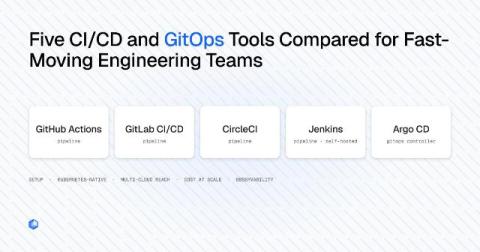
Five CI/CD and GitOps Tools Compared for Fast-Moving Engineering Teams
Your pipeline works. The build passes, the image lands in the registry, and the job turns green. Then someone asks why production still runs the old version, and you spend the next two hours determining whether the problem is a deployment configuration, a runner, an approval rule, or the runtime itself. That is the wrong-tool tax.

Integrating Virtual Identity Systems into Modern DevOps and CI/CD Workflows
Modern IT service management and cloud operations rely heavily on automated identity validation, multi-factor authentication (MFA) testing, and isolated staging environments. Deploying cloud infrastructure at scale requires continuous verification without linking critical operational workflows to physical mobile hardware. DevOps engineers building automated alert pipelines or synthetic monitoring suites often implement a dedicated virtual number to receive SMS payloads, isolate production keys, and validate two-factor authentication endpoints programmatically.
CircleCI Smarter Testing: Stop running tests that don't matter
Testing consumes up to 50% of CI/CD pipeline time. That’s the single most expensive place in your delivery pipeline, and a meaningful share of that time is often wasted running tests unaffected by the change. Every time a developer pushes a commit, the full test suite runs. A two-line bug fix in auth.py triggers 2,000 tests, including 1,900 that don’t touch anything near auth.py. Those unrelated tests are overwhelmingly likely to pass, but the pipeline still spends 20 minutes running them.

How to Route Package Traffic Through JFrog PTC With Zscaler: Setup and Policy Configuration
JFrog’s Package Traffic Controller (PTC) intercepts an organization’s public package traffic at the network layer and routes it through JFrog, so JFrog Curation policies and audit logging apply to every intercepted install without changing how developers work.

It's your coding agent's first day on the job
They’re gonna need some context.
The minimum viable path to CRA compliance
You don't need a complete compliance program on day one to make real progress on CRA. You need to close the most visible gaps first. This video covers where to start: None of this is CRA-specific busywork. It's the same foundation most mid-sized software companies need regardless of the framework.
You can't audit an AI model the way you audit a binary
Open up an AI model and what's actually inside is a floating array of decimal points. No one can look at that and confirm it hasn't been tampered with, doesn't contain bias, or wasn't trained on poisoned data. This video covers why that changes how you need to think about trusting a model: If you can't unpick the model itself, you have to be able to trust its origin.