Operations | Monitoring | ITSM | DevOps | Cloud

[Webinar] - JFrog & AWS - Edge & Hybrid Software Distribution

Are you looking to migrate and modernize your infrastructure with AWS edge services? Do you need to distribute your software releases globally? JFrog and AWS have the answers to your hybrid infrastructure needs. JFrog will be hosting a webinar with Anuj Sharma, AWS Container Specialist Solution Architect, and Sven Ruppert, JFrog Developer Advocate.

A Two-Way Jira Speedway, the JFrog Artifactory App

The path between two clouds ought to be a speedy two-way street. That’s the DevOps pipeline principle behind the JFrog Artifactory App for Jira, which forges a traceable link between your issues in Jira Cloud and your builds in Artifactory on the JFrog DevOps Platform for cloud. Once the app for Jira has been installed you can: The JFrog Artifactory app, now available in Atlassian Marketplace, currently works with JFrog Platform cloud accounts and Atlassian cloud accounts.

Introduction to Artifactory on the JFrog Platform

Everything you need to know about JFrog Artifactory: The how, the what, the where, and when to use Artifactory as part of your application delivery. At the heart of the JFrog DevOps Platform, Artifactory provides universal management for all binary artifacts, container images and Helm charts used throughout your SDLC. Learn how to use Artifactory, tips and tricks for improving your developer productivity and best practices for using Artifactory as part of your CI/CD pipelines to accelerate your releases.

Our Groundbreaking Partnership with Docker Is a Boon for DevOps Teams

Today we’re announcing a big move that will yield substantial, concrete benefits for our customers and for the entire DevOps community: A groundbreaking partnership with Docker that exempts Cloud users of the JFrog Platform from Docker Hub’s image-pull rate limits. This agreement further boosts JFrog’s vibrant ecosystem of integration partners, built on the “too integrated to fail” principle that’s been a pillar of our company since its founding.

Distribute Software Releases Globally with JFrog on AWS

Release management is a topic that leaders in DevOps teams should be concerned with as organizations move toward implementing systems of automated continuous deployment. The practice will make your organization more efficient, but how do you implement it? Modernizing your infrastructure for the cloud is essential to distributing trusted releases globally. Many enterprises choose AWS as their platform, and seek to use AWS edge services to distribute their production applications to nearby end-points.

Set up a CI/CD Pipeline with Cloud-Native Tools

The adoption of cloud-based solutions has become increasingly common. The proof for this is evident – according to Gartner, Inc., the worldwide public cloud services market is expected to grow by 6.3% in 2020, up to a staggering $257.9 billion in value. The Flexera 2020 State of the Cloud Report, released on April 28, 2020, states that more than 90% of respondents have adopted cloud computing, with the top three cloud service providers being – AWS, Azure, and Google Cloud Platform.

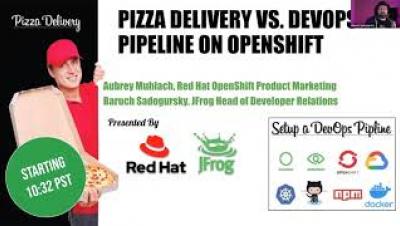
JFrog & RedHat - Pizza Delivery vs. DevOps Pipeline On OpenShift

In this webinar, Baruch Sadogursky of JFrog and Aubrey Muhlach of Red Hat will demonstrate the ease of supporting DevOps with a fully-fledged pipeline in a cloud. From source control, CI server, artifact repository, security vulnerability and license compliance scanner, Docker registry, Helm repository... all the way to runtime, with OpenShift, tracing and monitoring tools. We mean EVERYTHING! So, by using the K.I.S.S. principle (keep it simple) applied to a bunch of SaaS tools, we can create an entire DevOps pipeline in 30 minutes or less! Or can’t we?

Discord Bot Part 1: Getting started the right way

I’ve recently started working on a new project to build a Discord bot in Go, mostly as a way to learn more Go but also so I can use it to manage various things in Azure and potentially elsewhere. I figured it’d be useful to document some of this project to give some insights as to what I’ve done and why. First up was setting up the CI/CD pipeline for it so that I don’t need to worry about it later and can save myself a bunch of time when testing.

Introducing a New Pull Request Sidebar

Bitbucket Cloud’s pull request sidebar is useful because it displays all the relevant details of the pull request you’re looking at. However, with so much information present, it can be hard to find the information you need. To address feedback we’ve received about its readability and usability, we’ve given it a redesign.

Integrating a Cloudsmith repository with a CircleCI pipeline

At Cloudsmith, we are proud of our partnership network. We work hard to collaborate and integrate with the best DevOps tools available. Building performant, modern workflows requires frictionless integrations between tooling. Integrating Cloudsmith repositories with your CI/CD processes facilitates rapid development. Build, test, and deploy/distribute your software in repeatable, performant ways.

Building w/ Observability- Honeycomb & CircleCI

Do you know exactly what your builds are doing at every step of the way to prod and after they’ve been deployed? A key part of what lets you ship code to production often and quickly is having observability in your builds. Together, CircleCI and Honeycomb can help you get both speed and quality when shipping code to production. In this webinar, we’ll not only examine how CircleCI and Honeycomb work well together, we’ll also look at how Honeycomb used both products together to identify changes that impacted their build times and reduced them by 25%.

CI/CD quick tip: Custom Slack message on code deployment

Notify Slack on deployment with a message customized for your team. This video walks you through how to create a Slack app, register a webhook, and use that webhook in your continuous delivery pipeline to send a custom message to Slack. If you don't want to do it yourself, try deployment notification in Sleuth. LINKS SLEUTH.

The Year DevOps Leaped to the Center

At the beginning of 2020, none of us could have imagined what we would be talking and thinking about at the end of the year. At JFrog, we began by talking about unifying everything in the DevOps lifecycle. Of course very quickly, the message of unity and togetherness would soon become even bigger than we could imagine in light of the global pandemic.

Simply the Best: JFrog's Top DevOps Articles from 2020

In 2020, JFrog’s experts published a treasure trove of content — blogs, articles, infographics, and more — to share insights and advice with our customers and the DevOps community at large. In case you missed them — or want to re-read them — here’s a list of the most popular ones. They range from a primer on container registries to an explainer on achieving high-availability for your Maven repository.

Deploying applications to Kubernetes from your CI pipeline

Now that we know the advantages of leveraging Ketch over other tools such as Helm to ease the deployment of our applications (BLOG: Helm vs. Ketch when Deploying Applications), a good next step is for us to understand how we can tie Ketch to our CI pipeline and have an automated deployment process. For this example, we will leverage Ketch, GitHub Actions, and a Kubernetes cluster on Google Kubernetes Engine (GKE).

Find the Path to Go Module Major Versions With GoCenter

How many major versions of a given Go module are there? That simple question doesn’t always have an easy-to-discover answer. Golang’s unique system of semantic import versioning solves some key problems of ensuring Go module compatibility across dependencies. But it also makes it a bit harder to learn what major versions of a Go module are available. The go client doesn’t provide a way to find out, nor will it inform you when a newer major version of a dependency exists.