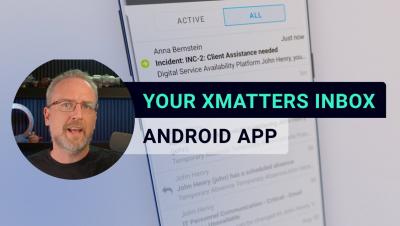
Your xMatters Android Inbox - xMatters Support
Join Chris Patch, xMatters’ Senior eLearning Specialist, as he walks through your xMatters inbox in the xMatters app on Android devices and how to take advantage of it best.


The latest News and Information on APIs, Mobile, AI, Machine Learning, IoT, Open Source and more!
“We need to be an AI-enabled company.” Replace the “AI” with any technology from history and this comment becomes a common refrain across businesses lured by the promises of new technology and fueled by FOMO (a fear of missing out). As enterprise strategists and former CXOs who have lived through many “technology is the solution, now what was the problem?” conversations, we talk extensively about this issue.
When the internet first came into existence in 1983, its communication channels didn't exist, and it was just operational enough to be used for research purposes. In 1989, Tim Berners-Lee had the idea to develop a system for the internet using TCP/IP protocols. That public project at CERN introduced HTTP, HTML, World Wide Web (WWW), and a client-server as communication mechanisms. In this post, you'll learn how HTTP protocol works and how new versions brought it to where we are now, with the widely used HTTP/2 in 2021.
The Internet of Things adoption is growing faster than ever before. As connected devices become more affordable, they find their place in many aspects of our lives. Users worldwide can benefit from a large ecosystem of IoT solutions. However, this rapid growth comes at a cost. Different IoT edge devices have different interfaces, speak different languages and many are not supported soon after manufacturing. Over time, this presents challenges not only to usability, but also to security and privacy.
Is it possible to use just one tool to test everything? Although it may sound like a developer’s daydream, it is almost possible with Cypress, a JavaScript frontend testing framework. Cypress is built specifically for JavaScript frontend developers, and they can use it to start writing tests quickly without needing to add third-party dependencies or packages. This is a benefit missing from other tools like Selenium. In this tutorial, I will guide you through using Cypress to test an API.
In the last 2 installments (Part 1 & Part 2), we discussed the basics of IoT and an example of how the components can be connected and used to provide basic automation and alerting. These seemingly simple steps can build up to provide very advanced controls of all aspects of the physical world. The challenge can become managing situations that were not expected.
If you’re a current user of Agile Requirements Designer (ARD), you are most likely using ARD to design your functional tests. But did you know that you can use ARD to create API tests that can be executed with your test automation framework? In this blog, I’ll share five real use cases for creating API tests with ARD. These examples come directly from our customers, and illustrate how our powerful model-based approach can scale your API testing.
François, Chris, and I started Interrupt 2.5 years ago because we wanted a repository of great embedded firmware content, which didn’t exist. Looking back at all the posts that our community contributors have published, we think we’ve made a respectable attempt at this goal. Our goals for Interrupt were always more ambitious than just a blog with quality content. We wanted Interrupt to become a hub for everything related to embedded firmware.
MobX is a scalable library developed to ease the process of state management in frontend applications. In this tutorial, you will learn how to manage the state of your Flutter applications using MobX, and then set up a continuous integration/continuous deployment (CI/CD) pipeline for your application using CircleCI. You can find the sample project developed for this tutorial in this GitHub repository.