Operations | Monitoring | ITSM | DevOps | Cloud

AI Agent Security: Applying the OWASP Top 10 Across the Software Development Lifecycle

Learn how to secure AI agents across development, testing, deployment, and runtime using the OWASP Top 10 for Agentic Applications. A single poisoned web page can be enough to hijack an AI agent. As organizations move from AI assistants that generate responses to autonomous agents that take action, the security risks are changing. An agent can access sensitive data, execute code, modify configurations, and interact with external systems.


Property-based testing: How to find bugs your unit tests miss

Property-based testing is a software testing technique that checks whether a program satisfies general rules, called properties, across many automatically generated inputs. Instead of writing tests for individual examples, developers define how their code should behave and let a testing framework search for inputs that break those rules.

Introducing CircleCI Functions: Reusable CI steps built for coding agents

CircleCI Functions are now available in beta, giving developers and coding agents a faster, more reliable way to set up CI pipelines using reusable, tested steps. Functions are the next evolution of CircleCI orbs. They make common CI tasks, like installing programming languages, configuring AWS credentials, and setting up Docker, available as ready-to-use programs that agents can discover, configure, and validate before running a pipeline.

The Evaluation Factory: How We Make Agents Measurably Better, Run After Run

Ask a team running an agent in production whether last week’s change made it better. Most can’t say. They swapped a model or rewrote a skill, eyeballed a few runs, and moved on. That works for a demo. It doesn’t work for an agent that touches production, where customers want two things that pull against each other: precision where a mistake is expensive, and low cost where the work is routine. A root cause someone acts on has to be right.

The voice of the customer at the heart of progress: why NPS matters to Almaden?

The customer satisfaction survey is more than a metric. It is the tool that connects users’ real-world experiences to the decisions shaping the future of Collective IQ. At Almaden, we believe that a product is not built solely on technical requirements or market trends. Above all, it is built by listening to the people who use it every day. That is why Net Promoter Score (NPS) plays a central role in our strategy. It is not just a number.

Never lose robot data again: automatic ROS 2 bag recording and upload

If you work with robots, perhaps you’ve come up against a common, but annoying situation: the one field run that mattered is the one nobody recorded. Or it was recorded but the ROS 2 bag (a recording of ROS 2 topics) is sitting in the robot’s storage, at a customer site, three time zones away. This issue is commonly caused by manually starting ros2 bag record and using scp to copy gigabytes off the robot after every test, which just does not scale.

What's New in VictoriaMetrics Cloud Q3 2026? VictoriaTraces, a Revamped Overview and Monitoring, Alerting for Logs and Traces, and a new Beta coming soon

Q3 2026 has been one of the greatest quarters for VictoriaMetrics Cloud, and that is thanks to the whole team, including open source, of course. The big milestone is that VictoriaTraces is now part of VictoriaMetrics Cloud, which means that the full VictoriaStack lives in one managed place, with a single bill and the same experience users already know.

Pushing metric concurrency, cardinality, compute and retention limits with $1000 of infrastructure

We gave five metrics backends the same budget, the same week of data and the same ten queries, then ran those queries at rising concurrency. At one query at a time, the open source engines looked strong. Under concurrency, two of them stopped answering, and the rest slowed down by an order of magnitude.

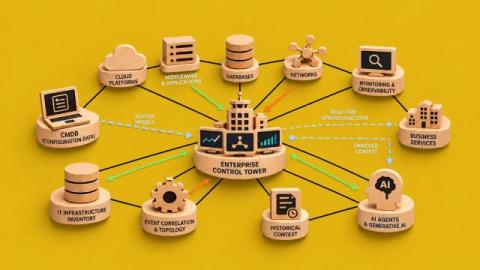
Why AI-Ready IT Operations Need More Than a Traditional CMDB Now?

Configuration Management Databases (CMDBs) have long played an important role in IT Service Management, providing a structured record of technology assets, their configurations and relationships. For enterprises managing complex IT environments, they remain a valuable foundation for understanding infrastructure and supporting operational processes.

Finding performance wins in our own traces with a coding agent

For the last few weeks I’ve used a coding agent to find and fix backend performance issues in Sentry, starting from the traces Sentry sends to itself. Most of the fixes only changed a line or two. But together, they removed hundreds of millions of queries a week, and some expensive lookups became hundreds or thousands of times faster (more details on that below).