Operations | Monitoring | ITSM | DevOps | Cloud

Is Your UV DTF Printer Ready for Growth? 7 Production Bottlenecks

Buying a UV DTF printer is often treated as a simple equipment decision: compare specifications, choose a machine, and start producing. In practice, the printer itself is only one part of a much larger production system. A machine that works perfectly for ten orders a week may become frustrating when demand doubles. The problem is not always that the printer is too slow. Supplies, workspace, maintenance routines, file preparation, finishing, replacement parts, and operator time can all become the real constraint.

Sponsored Post

Raygun APM Agent 3.0.14: faster, simpler, and ready for ARM64

Today we are releasing Raygun APM Agent 3.0.14 for Windows, Linux, and Azure App Service. This release is the result of a substantial modernization of the Agent, profiler, installers, and release pipeline. It makes Raygun APM easier to deploy, reduces overhead in several critical paths, adds native Linux ARM64 support, and lets developers investigate APM data through Raygun API v3 and the Raygun MCP server. If you are upgrading from version 2.3.0, there is much more here than a version-number change.

From Handwritten Mocks to proxymock: The Complete Loop

Handwritten mocks are cheap one at a time. This series built enough of them to show how quickly that stops being true. Nine posts took one package notifier from a function returning "delayed" to a captured response from a real carrier. Along the way, we hand-authored canned successes, failure cases, a spy, a stateful fake, an HTTP server, response fixtures, and contract-drift tests in four languages.

Top Tips: How to be a tech-savvy traveler

Top tips is a weekly column where we highlight what’s trending in the tech world and share ways to stay ahead. This week, let's look at a few ways you can be a tech-savvy traveler. Being a traveler is not easy, but with today's modern technology, it has become much easier. When we travel to places with no network, we sometimes forget about the ways we can use technology. Excluding the more familiar, I'm going to list some lesser-known tips. 1.

Making Shared GPUs Even Safer with Kubex and HAMi-core

Table of Contents A few months ago, we introduced Kubex support for the KAI Scheduler to improve GPU sharing for production inference workloads. The basic model is simple: The KAI Scheduler handles placement and GPU sharing. Kubex continuously observes usage and adjusts those allocations as demand changes. KAI provides the scheduling foundation. It lets multiple workloads share a GPU while accounting for the amount of GPU each workload requests. Kubex then closes the loop.

What to Know About AI Code-to-Merge Platforms

AI coding agents can generate pull requests at a pace your team has never seen. The bottleneck has shifted from writing code to everything that follows: reviewing, iterating, and merging. AI code-to-merge platforms are the category of tools built to manage that entire lifecycle, from the moment an agent starts working to the moment code lands in your main branch. This article walks through ten questions you should ask before committing to a platform.

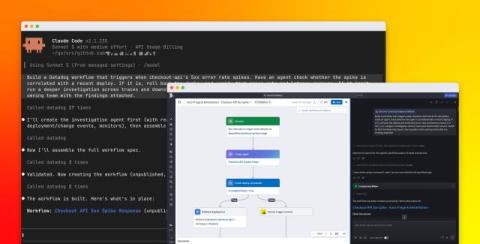
Build and run Datadog workflows from Bits Chat or AI agents

Teams use AI coding agents and Bits Chat to troubleshoot systems and handle complex tasks, often uncovering repetitive work worth automating. But turning those routines into workflows can still require switching tools and recreating context manually. Through the Datadog MCP Server, Workflow Automation now lets you build workflows from Bits Chat or AI coding agents like Claude Code, Cursor, and Codex.