Operations | Monitoring | ITSM | DevOps | Cloud

How to verify your Azure Application Gateway is zone-redundant

Having a redundant failsafe is one of the best things you can do to ensure high availability in the cloud. It’s rare for cloud regions to go offline, but it can happen, even on major platforms like Azure. While you might not have control over your provider’s reliability, you do have control over your own, and redundancy is a key part of that. Here’s how you can check if your Application Gateways are availability zone (AZ) redundancy, and how to verify redundancy using active testing.
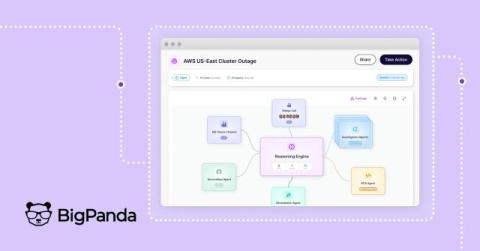
Introducing Swarm Investigation from BigPanda: Autonomous, multi-agent IT incident investigation

When a major incident opens, the opening minutes often become a race across disconnected tools and competing theories. One engineer checks a monitoring tool. Another scrolls through change records, looking for the one line that explains everything. A third pings Slack, asking if anyone has seen this before. While these are reasonable steps, taken one at a time, in sequence, they are far too slow.

Reliability Is the Test Agentic NetOps Has to Pass

It is 2:14 a.m. An agent has correlated a latency spike to an asymmetric routing condition and is ready to reroute traffic away from the affected path. The plan looks right. The only question that matters to the on-call SRE is whether to let it run, and that question is not really about the agent. It is about whether the picture the agent reasoned from is complete enough to trust at 2 a.m. with production on the line.

Introducing Spike's new look: designed to scale.

Today, we are introducing Spike’s new logo, a new website, and honestly, a new identity from the ground up. This is very exciting day for all of us at Spike. More companies are being built today than at any other point in history. Small teams are making big products. And no matter the size of the team, every single one of them needs reliability. Reliability should not be a second-class citizen for any company, no matter where they are in their journey.

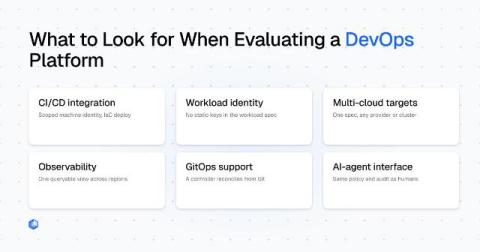
What to Look for When Evaluating a DevOps Platform

DevOps platform feature lists increasingly look alike. CI/CD, multi-cloud, observability, GitOps, and AI-friendly automation can all appear as checkboxes while the implementation burden still falls on your team. The useful signal appears when you ask how each capability actually works, what evidence a vendor can show, and which parts your team still has to build. Can pipelines authenticate with a scoped machine identity? Can workloads reach cloud APIs without static keys?

Building AI Systems That Survive an Audit: Evidence Trails, Traceability and Compliance by Design

A model returns an answer with a confidence score of 0.94. The team ships it. Six months later someone asks why the system produced that specific answer, and nobody can reconstruct it. For years accuracy was the only number that mattered in machine learning. Get the error rate down, ship the model, move on. In regulated domains that is no longer enough. The harder question is whether you can defend a single decision after it has been made. Most systems were never built to answer that, and by the time someone asks, the information needed is already gone.

Headless vs. Traditional Web Architecture: What DevOps Teams Need to Consider

DevOps teams face a critical architectural decision when building modern web applications: should they stick with traditional, monolithic systems or embrace headless architecture? This choice affects everything from deployment workflows to team collaboration, performance optimization, and long-term maintenance costs. Understanding the technical and operational implications of each approach helps teams make informed decisions that align with their specific requirements.

Why Growing B2B and DTC Brands Are Rethinking Their Ecommerce Infrastructure in 2026

A growing number of B2B and DTC brands are running the same calculation this year: what their ecommerce stack actually costs once every app subscription, integration fix, and developer hour gets added to the platform fee. The answer is pushing a broader look at ecommerce infrastructure itself, not just which platform sits underneath it.

Before You Buy a Hydraulic Heat Press: Run This DTF Production Bottleneck Audit

A hydraulic heat press makes sense when the press station is a measurable production constraint, not simply because a shop is getting busier. Before upgrading, track where orders wait, how much operator time pressing requires, how often work is re-pressed, and whether the press can keep pace with printing and garment preparation. If the queue consistently forms at the press, an upgrade may solve a real workflow problem. If delays start somewhere else, a new press may only move the bottleneck.

One DTF Printer or Two? A Smarter Capacity Plan for Growing Print Shops

Buying more DTF printing capacity sounds simple: if orders are increasing, buy a faster machine. In practice, growing print shops face a more important decision. Should you replace the current printer with a higher-output model, or keep it and add a second production machine? The better answer depends on more than print speed. Order concentration, maintenance windows, rush-job frequency, operator capacity, artwork mix, and the cost of production downtime all affect which setup gives a shop more usable capacity.