Operations | Monitoring | ITSM | DevOps | Cloud

The latest News and Information on Databases and related technologies.

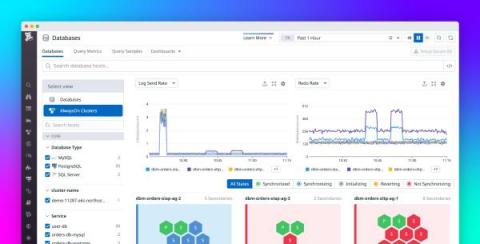
Monitor Azure Cosmos DB for PosgreSQL with Datadog

Azure Cosmos DB for PostgreSQL is a fully managed relational database service for PostgreSQL that is powered by the open source Citus extension. With remote query execution and support for JSON-B, geospatial data, rich indexing, and high-performance scale-out, Cosmos DB for PostgreSQL enables users to build applications on single- or multi-node clusters.

What To Know About Microsoft Azure PostgreSQL Hyperscale

As organizations adopt cloud technologies and modernize their applications, the data they generate and ingest often grows exponentially, leaving them with difficult choices for storing and using this data. Customers are beginning to explore moving away from traditional relational database management systems (RDBMS) because of the data volume to be ingested, as these RDBMS often cannot handle workloads.

Why Use a Purpose-Built Time Series Database?

For many workloads, using a time series database is a smart choice that saves time and storage space. Developers and companies have more database choices than ever. Choosing the right database for a project saves time when writing and querying data. As companies work with larger datasets to make increasingly intelligent and automated systems, efficiency is key. For many workloads, using a time series database is a smart choice that saves time and storage space.

Comprehensive Guide on Partitioning and Sharding in Azure Database for PostgreSQL

One of the biggest mistakes I’ve had to repeatedly help companies fix has been poor partitioning design. I’ve seen many database architectures designed in an attempt to make queries faster. While faster queries can be a product of implementing partitioning correctly for a given design, I’ve often seen query response times get much slower from implementing partitioning incorrectly for the database design.

Common SQL Server challenges and how Applications Manager's SQL Performance Monitor helps you overcome them

Database management systems are an essential component of business applications. Over the years, MS SQL has earned its place in the hearts of database administrators (DBAs) as the most trusted relational database management system. It is still the go-to choice for many DBAs as it helps them leverage its extensive capabilities across various dimensions such as security, portability, transaction processing and analytics.

Upsun partners with MongoDB to help customers build modern applications faster

Today, we are excited to announce that Upsun now offers the latest version of MongoDB to our Enterprise and Elite customers. Clients can now enjoy improved visibility via one source of control, the ability to track multiple applications and users, and native, at-rest encryption that meets the latest security compliance standards. There are more details about the benefits of MongoDB below.

How to monitor Oracle DB with Google Cloud Platform

Monitor Oracle DB in Google Cloud Platform with the Google Ops Agent. The Ops Agent is available on GitHub, and makes it easy to collect and ship telemetry from dozens of sources directly to your Google Cloud Platform. You can check it out here! Below are steps to get up and running quickly with observIQ’s Google Cloud Platform integrations, and monitor metrics and logs from Oracle DB in your Google Cloud Platform.

Missing indexes in PostgreSQL? How to quickly identify it

While working on improving the Netdata PostgreSQL collector, we were monitoring our production PostgreSQL instance and something caught our attention immediately. The rows fetched ratio seemed really, really low for one particular database… there were missing indexes in PostgreSQL! Rows fetched ratio is the percentage of rows that contain data needed to execute the query (rows fetched), out of the total number of rows scanned (rows returned).