Intro to Kubernetes and Rancher - 2020-08-06
This is the training from 2020-08-06 on Kubernetes and Rancher, given by Adrian Goins, the Director of Community and Evangelism for Rancher Labs. Come laugh and learn Kubernetes!


The latest News and Information on Containers, Kubernetes, Docker and related technologies.
Kubernetes has a lot of features and deployment options for running containers. One of these is the DaemonSet. In this blog post, we’ll discuss what a DaemonSet is, what it can be used for, and how to create and update them.
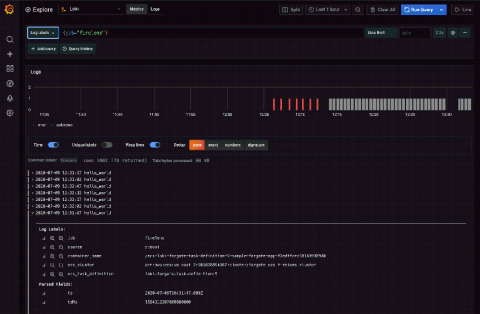
Elastic Container Service (ECS) is the fully managed container orchestration service by Amazon. Combined with Fargate, Amazon’s serverless compute engine for containers, you can run your container workload without the need to provision your own compute resources. But how can you consolidate and query all of your logs and metadata for these workloads? Enter Loki, the log aggregation system from Grafana Labs that has proven to increase performance and decrease costs.
Learning how to monitor etcd is of vital importance when running Kubernetes in production. Monitoring etcd will let you validate that the service performs as expected, while detecting and troubleshooting issues that could take your entire infrastructure down. Keep reading to learn how you can collect the most important metrics from etcd and use them to monitor this service. etcd is a foundational component of the Kubernetes control plane.
Microsegmentation is a security technique that is used to isolate workloads from one another. Microsegmentation limits the blast radius of a data breach by making network security more granular. Should a breach occur, the damage is confined to the affected segment. Application workloads have evolved over time – starting from bare metal, to a mix of on-prem and cloud virtual machines and containers.
When monitoring third-party applications with Prometheus, you’ll need an exporter if the application doesn’t already expose metrics in the appropriate format. How do you find an appropriate exporter, and once you have your exporters, how should you organize your label taxonomies to reflect your infrastructure? Many applications in the systems you’re in charge of will be third-party applications, which do not natively expose Prometheus-formatted metrics.
PostgreSQL is an open source database known for its reliability and performance. It’s used across many industries and applications, and is especially a favorite of web developers. All major web frameworks support PostgreSQL natively, from node.js and Django to Rails and Spring, so its adaptation is relatively broad across the internet for site backend systems. As with any database, developers need tools to work with them. Pgweb is an open source, web-based client for PostgreSQL.
Many organizations use Kubernetes to quickly ship new features and improve the reliability of their services. Rancher enables teams to reduce the operational overhead of managing their cloud-native workloads — but getting continuous visibility into these environments can be challenging. In this post, we’ll explore how you can quickly start monitoring orchestrated workloads with Rancher’s built-in support for Prometheus and Grafana.