The latest News and Information on Containers, Kubernetes, Docker and related technologies.
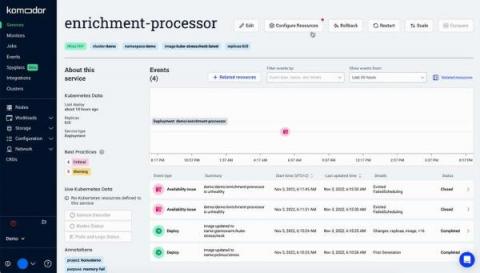
As a developer, it can become challenging to manage Kubernetes and develop applications simultaneously. That’s why we put together this guide to show you how the Kubernetes Dashboard can help developers overcome this problem and get an overview of the cluster and its workloads. From this, developers can focus more on application development while stressing less on cluster management.
Recently I started hearing more and more about developer experience, which to me was a bit new-ish, so seriously what is developer experience? Another buzz word? A real thing? It’s been a while since I actually developed code … yes yes … you can laugh … a sales person that used to be a developer 😃, and A LOT changed since then. The number of tools a developer should work with on a daily basis is just crazy.
Kubernetes 1.26 is about to be released, and it comes packed with novelties! Where do we begin? This release brings 37 enhancements, on par with the 40 in Kubernetes 1.25 and the 46 in Kubernetes 1.24. Of those 37 enhancements, 11 are graduating to Stable, 10 are existing features that keep improving, 16 are completely new, and one is a deprecated feature. Watch out for all the deprecations and removals in this version!
A recent Wall Street Journal article cited a KPMG survey that showed that roughly 67% of 1,000 senior technology leaders at U.S. firms across industries said they have yet to see a significant return on cloud investments. The most common issues preventing a better return on cloud spending were insufficient skills of tech teams, additional security and compliance requirements, and a misalignment with expected outcomes, said Barry Brunsman, a principal in KPMG’s CIO Advisory group.
Rancher, the open source container management platform, uses Fleet to enable its continuous deployment features. Fleet brings GitOps functionality to Rancher. Fleet in Rancher 2.7.0 can fetch Helm charts from OCI registries. Using OCI registries to store Helm charts is an increasingly popular storage method. It allows storing your charts in a registry alongside your container images. This unifies the storage options for charts and reduces friction. Using a chart in an OCI registry is fairly simple.
We are excited to announce that deploying Kubewarden in air gap environments has been simplified and documented! For that, you will need a private OCI registry accessible by your Kubernetes cluster. If you’re unfamiliar with Kubewarden, it’s a policy engine for Kubernetes. Its mission is to simplify the adoption of policy-as-code. Kubewarden policies are WebAssembly modules; therefore they can be stored inside an OCI-compliant registry as OCI artifacts.