Operations | Monitoring | ITSM | DevOps | Cloud

Smooth mocking with the Elasticsearch Node.js client

A classic problem that every backend developer has faced during their work is testing an application that uses a database. A perfectly valid solution is to use the real database for testing your application, but you would be doing an integration test, while you want a unit test. There are many ways to solve this problem. You could create the database with docker, or use an in-memory compatible one, but if you are writing unit tests that can be easily parallelized this will become quite uncomfortable.

SEMplicity: Scaling Large ECE Deployments

From the trenches: what does it really take to scale up a large Elastic security log deployment? Elasticsearch for enterprise security log storage & management is a hot topic today. Specular gains in performance, functionality and cost are ready for harvest. But what exactly does it take to create a large Elastic log storage infrastructure? This talk will present war stories related to at 150,000 events per second Elastic log storage implementation with 2 month retention built at a large commercial client.

Virtual Meetup: Elastic Workplace Search-Finding Where That Document Went

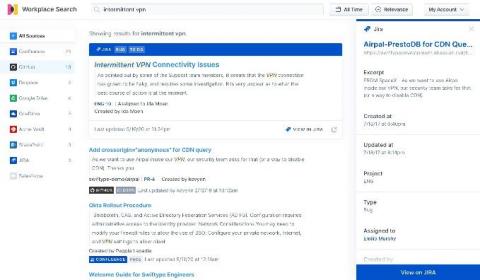
Supporting employees in a work from a home environment can be challenging. Do they have access to these systems? Can they locate the documents they need? This would be easier if documents are centrally located. In most organizations, documents can live in services like Dropbox, Goole Drive, and or Github. In this virtual meetup, I will show you how to create a search box between these different services and finally solve the question.. "Where did that document go?"

Free online Elastic Stack and Elasticsearch training: Anytime, anywhere, on-demand

We are offering a variety of on-demand Elastic training courses for free — featuring 11 titles that span observability, security, and Elastic Stack administration. If you haven’t tried one of our self-paced courses yet, now is the perfect time to find out why so many people have shifted their learning preference from in-class to online. Our on-demand courses provide the same immersive learning experience found in the classroom, but delivered in a convenient, remote environment.

Flattened Datatype Mappings - Elasticsearch Tutorial

In this article, we’ll learn about the Elasticsearch flattened datatype which was introduced in order to better handle documents that contain a large or unknown number of fields. The lesson examples were formed within the context of a centralized logging solution, but the same principles generally apply. By default, Elasticsearch maps fields contained in documents automatically as they’re ingested.

Getting Started with Grafana Dashboards using Coralogix

One of the most common dashboards for metric visualization and alerting is, of course, Grafana. In addition to logs, we use metrics to ensure the stability and operational observability of our product. This document will describe some basic Grafana operations you can perform with the Coralogix-Grafana integration. We will use a generic Coralogix Grafana dashboard that has statistics and information based on logs. It was built to be portable across accounts.

InfluxDB Community Office Hours - April 2020

InfluxDB Community Office Hours are one-hour, monthly online sessions, held on the 3rd Wednesday of the month at 10:00 am Pacific Time, by our Influxers to answer your questions about any topic related to InfluxDB or time series. We host this monthly live webinar so that users can directly ask a panel of Influxers questions and talk in real time. We record these sessions and post them on YouTube. InfluxDB Community Office Hours are part of our commitment to open source, developer happiness, and time to awesome.

InfluxDB Community Office Hours - April 2020

InfluxDB Community Office Hours are one-hour, monthly online sessions, held on the 3rd Wednesday of the month at 10:00 am Pacific Time, by our Influxers to answer your questions about any topic related to InfluxDB or time series. We host this monthly live webinar so that users can directly ask a panel of Influxers questions and talk in real time. We record these sessions and post them on YouTube. InfluxDB Community Office Hours are part of our commitment to open source, developer happiness, and time to awesome.