Operations | Monitoring | ITSM | DevOps | Cloud

Latest posts

runqlat and runqslower - eBPF command line tools

In this blog post we will look at runqlat and runqslower commands. They are available in both BCC and bpftrace tool collections. One of the core functions of Linux operating system is to schedule processes across available CPUs. When service gets a request, Linux typically will need to schedule the process, processing that request to run on one of CPUs. This might be very quick process if idle CPU is available or it can take significant time, if all CPUs are currently busy running different processes.

gethostlatency - eBPF Command Line Tools

In this blog post we will look at gethostlatency command. It is available in both BCC and bpftrace tool collections. Most applications and services use hostnames, rather than IP addresses to communicate with other services. This means before connection to the service can be established, another request needs to be made – to DNS (Domain Name System). As such its performance and availability impacts performance of virtually all services in your environment, yet it is often ignored.

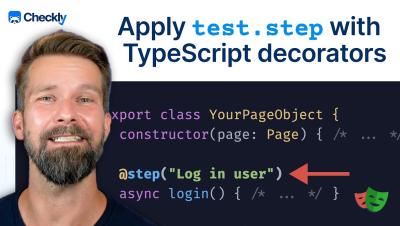
Apply Playwright test steps with TypeScript decorators

Join Stefan Judis as he explores the concept of decorators in Playwright TypeScript code. Learn how decorators can streamline your coding process, improve test readability, and save you time. In this tutorial, Stefan will demonstrate how to implement decorators within Playwright page object models, starting from scratch. He provides practical examples and insights into decorators, a feature not yet standard in JavaScript but available in TypeScript.


Why is observability important for TableFlow, and how does SigNoz help?

Monitor your applications and troubleshoot problems in your deployed applications, an open-source alternative to DataDog, New Relic, etc. Backed by Y Combinator. SigNoz helps developers monitor applications and troubleshoot problems in their deployed applications. SigNoz uses distributed tracing to gain visibility into your software stack.

How Cloud-Native Artifact Management Can Facilitate the Move to Platform Engineering

In this session we will explore why prioritizing artifact management is essential in advancing to self-service IDPs and how adoption of Cloudsmith offers solutions to common challenges such as high infrastructure costs, managing security vulnerabilities, and maintaining productivity. Attendees will gain insights into best practices of implementing an artifact repository at the center of their CI/CD pipeline.

How does Git work?

If you're like me and have less than twenty years of software engineering experience, the thought of a world without Git doesn't seem possible. When I started to research for this post, I almost fell out of my chair when I read that Git was created in 2005. It doesn't seem that long ago... either that, or I'm simply getting old. When I started programming, I asked myself a question I sometimes still ask myself today - How does git work? I often find myself being scared of certain Git commands.

Using K8S But Not Overhauling Your Devops Processes

Kubernetes is now the industry standard for cloud-based organizations. Slowly, many enterprises and mid-level companies are adopting it as the default platform for managing their applications. But we all know Kubernetes adoption has its challenges, as well as its associated costs. How do we decide when and what to migrate to Kubernetes? Does migrating to Kubernetes mean overhauling all DevOps processes? Adopting K8S should not lead to an overhaul of your DevOps process - it should complement it.

Implementing OpenTelemetry in Spring Boot - A Practical Guide

OpenTelemetry can auto-instrument your Java Spring Boot application to capture telemetry data from a number of popular libraries and frameworks that your application might be using. It can be used to collect logs, metrics, and traces from your Spring Boot application. In this tutorial, we will integrate OpenTelemetry with a Spring Boot application for traces and logs. Before the demo begins, let's have a brief overview of OpenTelemetry.