Operations | Monitoring | ITSM | DevOps | Cloud

Best Kubernetes monitoring tools compared in 2026: A buyer's guide for SRE, platform engineering, and ITOps teams

Monitoring Kubernetes in production is structurally different from monitoring traditional servers: pods are ephemeral, nodes autoscale, and the layered resource model—containers, pods, nodes, namespaces, deployments, services—creates an observability challenge that tools built for static infrastructure were never designed to handle.
Sponsored Post

How to cut AI infrastructure spending without reducing GPU capacity

Every infrastructure leader running AI workloads is staring at the same problem: GPU spending keeps climbing, the finance team wants a justification, and the operations team is caught between proving the infrastructure is necessary and explaining why the returns aren't keeping pace with the investment. The instinctive response is to either procure more capacity to handle growing demand or cut back on what's already deployed. Neither actually solves the problem.

Test PostgreSQL With the Queries Your App Actually Runs

The first number from my local PostgreSQL 16 test was roughly 1,600 statements per second. It looked impressive. It was also the least useful result in the run. The useful part was the workload. It came from queries the demo app had actually sent: the same prepared statements, parameters, reads and writes. A synthetic benchmark tells you how PostgreSQL handles a synthetic workload. It does not tell you whether your migration just broke the UPDATE your app depends on.

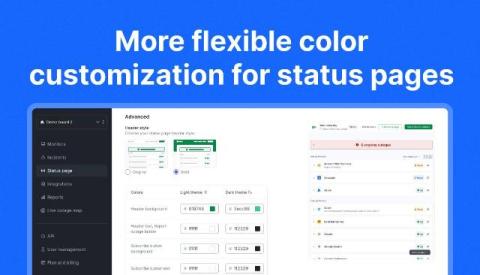
More flexible color customization for status pages

We’ve expanded status page color customization to give you more control over your branding and support a wider range of color combinations. Previously, you could select one primary color and one text color for each theme. These colors were applied across multiple elements, which could make it difficult to achieve the right contrast or match certain brand styles. Now, you can customize individual parts of your status page separately for both light and dark themes.

Why Manual SAP Patch Validation Fails

Validating SAP patches means answering three questions before anything reaches production: does this apply to my systems, what does it depend on, and what breaks if it goes wrong? For most SAP teams, the answer still comes from manual work. Someone reads the note, checks a component version by hand, updates a spreadsheet, and trusts memory for the rest. That can work, but it depends on one person’s head, or on a spreadsheet that slowly goes stale. The failure mode is usually not a bad patch.

AlmaIQ in practice: when AI solves productivity problems in minutes

In a market where new tools and technologies are constantly emerging, it is easy to get carried away by features. The real differentiator, however, lies in the impact a solution has on operations. That is what stands out most about Almaden’s solutions. More than a Digital Employee Experience (DEX) platform, it turns data into decisions. It enables IT teams to anticipate problems, act proactively, and improve the user experience.

When Peak Business Demand Depends on Information Nobody Sees

Modern enterprises no longer operate as isolated systems. Every customer order, supplier commitment, shipment, invoice, and payment relies on information moving seamlessly across a growing network of applications, partners, and business functions. In many SAP-driven organizations, SAP IDocs serve as one of the primary mechanisms for exchanging business information between various SAP and non-SAP systems. Most business users never see them, never interact with them, and often never hear about them.

Best Practices for Effective Healthcare Networks

An effective healthcare network is the IT infrastructure that keeps clinical and operational services reachable, responsive and diagnosable across hospitals, clinics, imaging centers, laboratories, remote sites, cloud services and vendor connections. A device can be up while Electronic Health Record (EHR) access, Picture Archiving and Communication System (PACS) retrieval, telehealth or a wireless clinical workflow is still slow or unavailable.

What is data mesh architecture? Data mesh vs. data fabric vs. data lake [Quick Question Ep. 1]

What is data mesh architecture, and how does it compare to data fabric and data lake? In this episode of Quick Question, we explain how data mesh connects distributed data sources without duplication or centralization, keeping data at its original location while giving authorized users secure, low-latency access, even in mission-critical and bandwidth-constrained environments.