

Operations | Monitoring | ITSM | DevOps | Cloud

Sentry's .NET SDK 7.0 is ready for .NET 11

Sentry’s.NET SDK 7.0 fully supports.NET 11, adds packages for generic hosts and Quartz.NET integrations… and has some breaking changes. For your app, this means: If you’re not ready for the breaking changes yet, we also released the Quartz.NET packages, SentrySdk.WithMonitor, the Hangfire cron changes and UseSentry() on WebApplicationBuilder on version 6.13.0.
Sponsored Post

C# logging: Best practices in 2023 with examples and tools

Monitoring applications that you've deployed to production is non-negotiable if you want to be confident in your code quality. One of the best ways to monitor application behavior is by emitting, saving, and indexing log data. Logs can be sent to a variety of applications for indexing, and you can then refer to them when problems arise.

More Power for .NET Developers: New Releases Across dotConnect and Entity Developer

We are excited to announce a new wave of updates across our.NET data connectivity and ORM product portfolio, delivering enhanced security, broader platform support, modern SQL Server compatibility, AI-ready capabilities, and productivity improvements for.NET developers.

MongoDB Query Tracing in .NET with Sentry + OTLP

If your.NET app talks to MongoDB, you almost certainly want to be able to measure DB performance so that you can effectively debug any performance issues you might run into. For that, you need to know which database command was running, how long it took, and whether this was a one-off blip or part of a broader pattern. Ideally, you also want to pivot from that trace to related errors and replays without stitching the story together by hand.

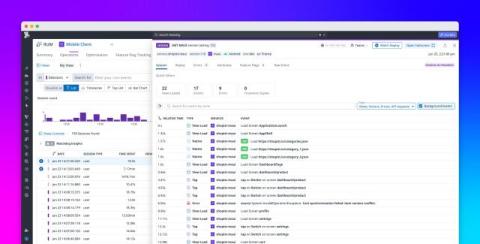
Monitor your .NET MAUI apps with Datadog RUM

As.NET Multi-platform App UI (MAUI) becomes the default cross-platform UI framework in the Microsoft ecosystem, many teams are standardizing on it to build mobile applications for iOS and Android. However, observability has not kept pace with the shift in adoption. Developers often rely on unsupported community bindings or maintain their own wrappers around native iOS and Android SDKs, which introduces instability and ongoing maintenance.

ADO.NET SQL Connection Providers for SQL Server Compared

Selecting an ADO.NET provider may seem like a simple, one-time decision, but it can affect performance, compatibility, and long-term maintainability for years. The provider sits between your application and SQL Server and affects everything from connection management and authentication to support for new database features. Also, today, SQL Server 2025 delivers new cloud-optimized features and modern security and System.Data.SqlClient has become legacy software.

3 Best PostgreSQL ADO.NET Providers for .NET Projects

In 2026, choosing the best PostgreSQL ADO.NET providers, or the right PostgreSQL.NET driver, comes down to the details. You need to know how they perform under load, how well they fit your stack, and what happens when things break. This guide compares the leading provider options side by side to help you identify the right fit for your environment. By evaluating these PostgreSQL ADO.NET providers, you can avoid pitfalls early, saving evaluation time and preventing costly fixes later.

Top 4 MySQL ADO.NET Providers for 2026

Modern.NET applications depend on stable ADO.NET providers to connect their logic with MySQL databases. But developers often run into familiar issues, async performance that’s unreliable, providers that differ in maturity, licensing that’s unclear, or integration friction with EF Core or cloud pipelines. In this guide, you’ll get a clear, architecture-based comparison of the top ADO.NET providers for MySQL.

5 Best ADO.NET Providers: Use Cases & Choosing Tips

Behind every modern.NET application is an ADO.NET provider handling database connections, queries, and ORM operations behind the scenes. As applications become more cloud-native and data-intensive, that provider layer has become far more important than many teams realize. Performance, scalability, deployment reliability, and even developer workflow can all depend on the quality of the provider underneath the application.