Operations | Monitoring | ITSM | DevOps | Cloud

The latest News and Information on Observabilty for complex systems and related technologies.

How does observability enhance operations in cloud native voice networks?

The 17th century saw the onset of the Scientific Revolution. It was a time of knowledge explosion. During this time, scientific practices were still evolving, with no universally accepted protocols for data collection and analysis. Individuals documented any observation, resulting in the collection of massive amounts of information, but much of it was hard to leverage to draw useful conclusions. The development of the scientific method provided a common approach to capturing and analyzing data.

The Role of Observability in Modern DevOps Pipelines

DevOps has radically transformed how organizations build and deploy software, enabling faster delivery with greater reliability. Within this transformation, observability has emerged as a critical foundation for success. Unlike traditional monitoring that simply tracks known metrics, observability provides deep visibility into complex systems, allowing teams to understand and troubleshoot issues they couldn't anticipate. This shift represents much more than a technical evolution - it's a fundamental change in how organizations approach system health and performance.

How Much Should I Be Spending On Observability?

I recently wrote an update to my old piece on the cost of observability, on how much you should spend on observability tooling. The answer, of course, is “it’s complicated.” Really, really complicated. Some observability platforms are approaching AWS levels of pricing complexity these days.

Traces & Spans: Observability Basics You Should Know

In modern software architecture, applications aren't just getting bigger—they're getting more distributed. With microservices, serverless functions, and containers running across multiple environments, understanding what's happening inside your systems can feel like trying to track a single raindrop in a storm. That's where traces and spans come in. These observability tools aren't just buzzwords—they're your secret weapon for making sense of complex distributed systems.

How to get started with frontend observability: A quick Grafana Faro example

Modern cloud-native applications and web browsers are highly complex, making it challenging to gain visibility into their performance. Without an effective way to track and measure frontend performance, it becomes difficult to monitor real user experiences, detect critical issues, assess website health, and ensure optimal functionality. But what if you could see exactly what your users are experiencing in real time?

Troubleshooting Java Applications with Coroot

Java applications run on top of the JVM — a powerful but complex runtime environment that re-implements many OS features. It has its own memory management, garbage collector, and dynamic code compiler (JIT). While these features help with performance and portability, they often make troubleshooting a real challenge. At Coroot, we recently improved our support for continuous profiling in JVM-based applications.

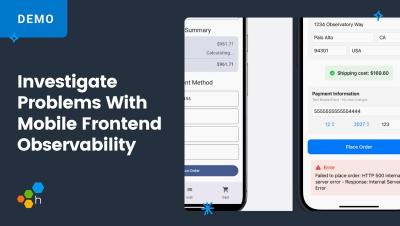
New Feature: Manage Your session.id in Honeycomb's Web SDK

The session.id field is special in Honeycomb for Frontend Observability. It’s a default option for filtering and grouping, and it’s the basis for session timeline analysis (in Early Access). Now you can control how session.id is set. In prior releases (< 0.15.0) of the Honeycomb Web SDK, we used our own UUID generator for session.id, and it was not accessible outside of the Web SDK itself. As of version 0.15.0, we give you full control.

App crash panic? #speedscale #developer #mocks #appcrashes #debugging #monitoring #tech #shorts

This video walks you through the first steps when your application goes down: check monitoring, validate alerts, rule out cache issues with incognito mode, and dive into your observability data to find the fix!

Data Strategy for SREs and Observability Teams

In Honeycomb’s Customer Architects team, we work with the full spectrum of team, scope, and budget sizes. “The data isn’t valuable enough” is something we’re always dismayed to hear, but we hear it often enough. The thing is, as much as we want it to not be true, no product or tool can magically maximize the value of your telemetry data—at least not without gobs of human input, oversight, and review.

The Power of Over 3000 Intelligent Observability Agents

Catchpoint has officially crossed a major milestone: over 3,000 intelligent agents now power our Global Agent Network. This isn’t just a big number. It underscores our commitment to helping our users monitor what matters, from where it matters most: the end user. With agents deployed across 105 countries, 346 cities, and every layer of the Internet stack, Catchpoint now offers the broadest and deepest visibility into user experience available today.