Operations | Monitoring | ITSM | DevOps | Cloud

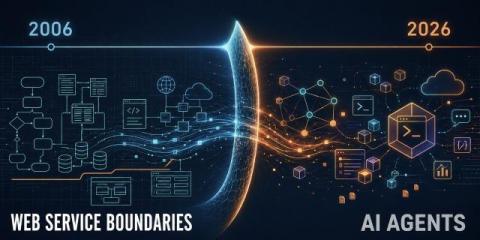
The silent infrastructure tax: why AI agents will break your legacy cloud

For the first time in a decade, humans are the minority on the open web. In 2025, automated traffic officially crossed the Rubicon to account for 51% of all web activity, while generative AI-driven referrals to retail sites surged by a staggering 693% year-over-year. As we move through 2026, these are no longer just "bot" statistics to be handled by a WAF. They represent a fundamental shift in user behavior. The fastest-growing segment of your audience is now agentic.

AppSignal's MCP Server: Connect AI Agents to Your Monitoring Data

Your AI coding assistant already knows your codebase. Now it can know your production environment too. AppSignal's MCP server gives AI agents and AI code editors direct access to your monitoring data — errors, performance metrics, and more — so they can help you debug, investigate and resolve issues without switching context. And with our new public endpoint, getting started is simpler than ever.

Best Enterprise Asset Management Software 2026

Best enterprise asset management software is becoming essential for organizations that manage large-scale operations, multiple facilities, and diverse asset categories. Enterprises today rely on advanced systems to monitor physical assets, digital assets, infrastructure, and operational equipment across departments and locations.

What are test hooks in AI-native development?

Summary: A test hook connects a test or lint command to an event in your AI coding agent’s workflow. When the event fires, the agent runs the command automatically. If it fails, the agent’s action is blocked. You can wire your existing test commands into your agent’s lifecycle hooks to get deterministic local validation before code ever reaches CI. AI coding agents write code at a pace where stopping to manually run tests breaks your flow.

What does the IBM acquisition of Confluent mean for the future of streaming and Kafka?

On December 8th, 2025, IBM announced a definitive agreement to acquire Confluent in a deal valued at $11 billion. It is a massive moment for our industry. The acquisition was finalized on March 17th, 2026. For some, this looks like a safe bet; a way for enterprise giants to finally "get" real-time data. But for those of us who have spent our careers in open source software and data infrastructure, it feels different. There’s a sense of wondering “when is the other shoe going to drop?”.

Resilience Testing Is Non-Negotiable in the Enterprise SDLC | Harness Blog

Outages in distributed systems are inevitable, making resilience testing essential in the SDLC. It must be continuous, covering failures, load, and disasters. Delayed validation creates “resilience debt,” increasing risk. A holistic approach—combining chaos, load, and DR testing—plus cross-team collaboration and AI-driven insights improves reliability and reduces impact. Modern software delivery has dramatically accelerated.

The Art of Prompting in AI Test Automation | Harness Blog

E2E Testing Has a New Bottleneck, and It's Not the Code End-to-end (E2E) testing has always been the hardest part of a QA strategy. You're simulating real users, navigating real flows, validating real outcomes across browsers, environments, and data states that never hold still. Traditional test automation tackled this with scripts: rigid, deterministic sequences tied to element selectors and hard-coded values. They worked until the UI changed. Or the data changed.

Network Documentation: Excel vs. DCIM Software

Spreadsheets and Visio diagrams may work in small, static environments, but they cannot maintain accurate, real-time records at the port level, track relationships between assets, or support the pace of change in modern operations. DCIM software is purpose-built for those demands. In this blog post, we'll cover what network documentation actually requires, where Excel and Visio fall short, and how DCIM software addresses those gaps.

How Does DCIM Software Support Edge Computing, IT Closets, and Distributed IT Environments?

DCIM software supports edge computing, IDF closets, and distributed IT environments by providing centralized asset management, real-time power and environmental monitoring, 3D digital twin visualization, capacity planning, and physical security management across every site from core data centers to remote sites and IDF closets.