Today we’re proud to announce the general availability of Relay, a cloud-native workflow automation platform. We launched our public beta of Relay last June, and we’re now officially out of beta and open for business! We’ve been pretty busy during the beta period - early users have executed thousands of workflows, processed tons of events, and given us incredibly helpful feedback.
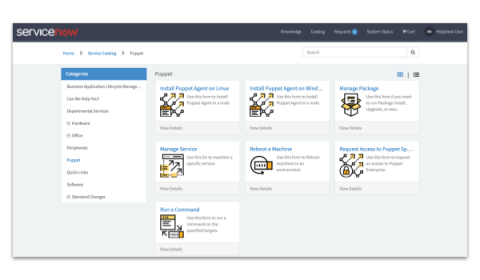
Whether you’re a current customer looking to expand across your Windows estate, or thinking of deploying Puppet across your infrastructure for the first time, we hope this blog post — based on real-world customer questions and problems — can help answer some of the questions you may have about Puppet.
Patching vulnerabilities can be daunting, especially if the information is confusing, and the process to deploy patches is long. There are going to be times where a zero day presents itself, and the vulnerability requires immediate action. Whether it’s a simple fix or not, the seriousness of some vulnerabilities can put organizations at risk. Deploying patches, especially for critical infrastructure, takes planning.
Take the 2021 State of DevOps Survey here. This year marks the 10-year anniversary of our industry-defining State of DevOps research. You’d think after 10 years that there wouldn’t be much more to say about DevOps, but practices and technologies continue to evolve, the best keep getting better, and we keep unearthing new topics to research.
I’ve got some exciting news! With the recent release of Puppet Comply 1.0.2, we’re providing the ability to assess Windows 2016 servers against DISA STIGs, required security standards for companies that do business with the U.S. Department of Defense. This new capability makes it drastically easier for organizations to assess and demonstrate compliance with DISA STIGs.
CIS (Center for Internet Security) is a non-profit organization that aims to develop a best practice in relation to cyber security. The CIS benchmarks have been adopted by many organizations as the standard against which to measure their systems.
The year 2020 upended life as we know it — yet amid worldwide shutdowns and cross-industry layoffs, the respondents to the 2020 State of DevOps survey reported an overall rise in salary levels compared to the past couple of years.
More and more, companies from small businesses to global enterprises are migrating or deploying workloads in public cloud environments. Typically, their goal is cost optimization, as public clouds can dramatically reduce on-premises infrastructure costs and corresponding maintenance labor costs. Instead of installing more servers, storage, and networking components in your own datacenter, public cloud environments allow you to deploy dynamic cloud resources, usually with a short to medium lifespan.