Operations | Monitoring | ITSM | DevOps | Cloud

Cribl On Your Coffee Break Episode 3 - Configuring Prometheus Remote-Write

In day 3 of our coffee break series, Leon continues to explore common observability data types and how to get them into Cribl. Today, we’ll look at setting up a simple Prometheus ingestion. By the time the month (and the series) is over, you will have a pretty good idea of what Cribl can do, and how to do it. You’ll also have consumed your body weight in caffeinated beverages...

Why compliance keeps slowing your releases (and what to change first)

A team ships at a steady pace for most of the year. Then an audit approaches, and delivery slows. Engineers get pulled off feature work to support the audit, producing the configuration exports, logs, and environment checks that the evidence depends on. The slowdown lasts as long as the audit does. It is tempting to read this as a team that needs to move faster or be bigger. It is usually neither.

How Logicalis Scaled Security Operations with Autonomous Endpoint Management

Learn how Logicalis, a global technology service provider, partnered with Ivanti to transform their IT operations. Discover how they leveraged automation and Ivanti Neurons to streamline workflows, reduce manual intervention, and deliver exceptional service at scale. Key Highlights: How Logicalis simplified complex global IT environments. The role of automation in improving service delivery and response times.

How Is AI Changing IT Operations? Building Production-Ready AI Agents with Alex Zinovy

How is AI changing IT operations, and what does it take to move AI agents from impressive demos to production-ready systems? In this episode of Agents of IT, Resolve’s Zack Austin sits down with Alex Cinovoj, Founder and CTO of TechTide AI, to explore what enterprise AI looks like when it has to work in the real world. Alex brings years of hands-on IT, infrastructure, DevOps, and AI engineering experience to a conversation about the shift from experimenting with AI to building trustworthy systems that deliver measurable outcomes.

LLM token cost: pricing per token explained

LLM token cost is the price a provider charges per token a model reads or writes, quoted in dollars per million tokens. Input and output bill at separate rates, with output priced at roughly 5x input. As of September 2026, published rates range from under $0.10 to more than $180 per million tokens on top-end reasoning tiers. In late 2025, Hardik Sonetta of Thomson Reuters Labs published a warning about the most common prompt caching mistake in production.

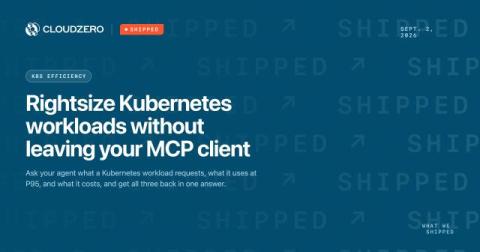
Shipped: Rightsize Kubernetes workloads without leaving your MCP client

Changing a Kubernetes resource request takes two numbers: what the workload requests, and what it uses. The CloudZero MCP server now returns both, by cluster, namespace, or workload. This gives you a number you can defend. Usage comes back as P95 over the date range you query, 30 days by default. When an engineering lead asks whether a service runs on a smaller request, that is the figure that settles it. Over-provisioning and under-provisioning show up on the same query.

Our Customer Success AI bill tripled. Here's why we're spending more.

Pop quiz: If you spend $40,000 per month on Anthropic, and you’ve got two customers, what’s your cost per customer? If you bypassed the easy answer of $20,000 and said, “Scott, you old trickster, that’s not enough information to answer that question,” you’ve won today’s prize: a lesson in the perils of average costs. Let’s flesh out the situation: You put an AI feature in your product, a document assistant powered by Claude.

For whoever has to explain the cloud bill to finance every month.

As infrastructure gets more complex, with workloads spread across clouds, regions, and providers, every hop your data takes between them adds up. Where do these costs actually come from? Has your team ever traced a surprise bill back to data movement? With Megaport, cloud egress costs are minimized by routing data privately between providers, avoiding the higher transfer rates associated with public internet routing.

env zero Demo: Discover Every Cloud Resource

See how env zero discovers and manages every cloud resource across AWS, Azure, and GCP—including resources deployed outside of Infrastructure as Code. In this overview, we walk through env zero's cloud resource discovery and environment migration capabilities. You'll see how the Cloud Compass dashboard maps your entire resource estate, how to tell whether a resource was created by IaC, click ops, or an API call, and how to bring existing Terraform workspaces and VCS repositories into env0 in bulk.

env zero Demo: Codify Everything

Turn manually-created cloud resources into Infrastructure as Code, then package that code into reusable templates your whole team can deploy. This walkthrough covers two env zero capabilities that work well together: using Cloud Compass to codify click ops resources into Terraform or OpenTofu, and building reusable templates so other users can deploy proven infrastructure without writing code or configuring integrations themselves.