Operations | Monitoring | ITSM | DevOps | Cloud

The latest News and Information on Monitoring for Websites, Applications, APIs, Infrastructure, and other technologies.

How Slack Transformed Their CI With Tracing

Slack experienced meteoric growth between 2017 and 2020—but that level of growth came with growing pains. In his talk at the 2021 o11ycon+hnycon, Frank Chen (LinkedIn), a Slack Senior Staff Engineer, detailed one of Slack’s biggest pain points in that period: flaky tests. A flaky test returns both a passing and failing result despite no changes in the code. At one point, between 2017 and 2020, Slack’s flaky test rate reached as high as 50%.

Practical CPU time performance tuning for security software: Part 2

In a previous blog, we discussed how to monitor, troubleshoot, and fix high %CPU issues. We also revealed a system API that could have an unexpected impact on CPU consumption. In this episode, we’ll discuss another time-related performance aspect that is unique to security software: application startup time. You don’t need to be a developer to benefit from this article.

Debugging with Dashbird: AWS Lambda Process Exited Before Completing Request

Another generic error message from our favorite FaaS provider AWS Lambda. And again, there are multiple reasons why this issue could arise. Let’s first look at the basics of AWS Lambda to get a better intuition for when things go wrong later. Lambda is an asynchronous event-based service at heart.

Why Serverless Apps Fail and How to Design Resilient Architectures?

We’ve been monitoring 100,000’s of serverless backend components for 3+ years at Dashbird. In our experience, Serverless infrastructure failures boil down to: These isolated faults become causes of failure due to dependencies in our cloud architectures (ref. Difference of Fault vs. Failure). If a serverless Lambda function relies on a database that is under stress, the entire API may start returning 5XX errors.

How to Move Kubernetes Logs to S3 with Logstash

Sometimes, the data you want to analyze lives in AWS S3 buckets by default. If that’s the case for the data you need to work with, good on you: You can easily ingest it into an analytics tool that integrates with S3. But what if you have a data source — such as logs generated by applications running in a Kubernetes cluster — that isn’t stored natively in S3? Can you manage and analyze that data in a cost-efficient, scalable way? The answer is yes, you can.

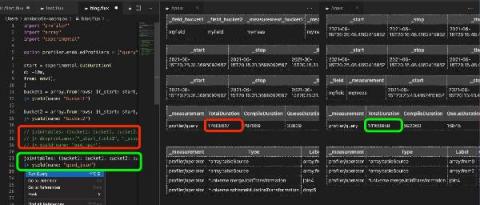
TL;DR InfluxDB Tech Tips - Optimizing Flux Performance in InfluxDB Cloud

So you’re using InfluxDB Cloud and you’re taking full advantage of Flux to create custom data processing tasks, checks, and notifications. However, you notice that some of your Flux scripts aren’t executing as quickly as you expect. In this post, we’ll learn about best practices and tools for optimizing Flux performance.

Pros and Cons of Free Web Hosting

Selecting a web hosting service is essential for making your site go live. But if you are starting up or have a limited budget, it is usually challenging to buy a hosting service costing as much as $100 per year. Most of the paid plans don't offer a free trial. If you just want to try a blogging idea, practice designing a website, or have limited to no earnings, you can get started with free web hosting.

Achieving Multi Cloud Integration With SD WAN

The adoption of a multi-cloud approach is inevitable. Yet many struggle with the transition to multi-cloud due to legacy MPLS VPN networks, which weren’t designed for the Cloud. In this video, we explain how we’ve helped customers to solve this problem utilizing SD-WAN to eliminate complexity and deliver a cloud-first architecture.

Surprising ways page loading time affects your bottom line

Avid kite flyer, publisher, and postmaster Benjamin Franklin is believed to have coined the catchphrase, “time is money”. If only he had known just how relevant the phrase would become hundreds of years later, especially when it comes to the relationship between customer expectations of your website’s page load times and lost revenue. Page load time is the time it takes your browser to retrieve a page, with all content, and display it in full.