Operations | Monitoring | ITSM | DevOps | Cloud

A CFO's Guide To Evaluating Cloud Spend

We have a term we like to use when we meet CFOs who have just gotten their biggest AWS bill ever: bill shock. Bill shock is when finance suddenly rings the alarm that the bill is “too high” and gets everyone scrambling to explain what they’re spending money on. It often happens when the bill reaches a new milestone (the first million, ten million, or hundred million) or growth trajectory (it doubled in a quarter!?). The problem with bill shock is that it can be highly disruptive.
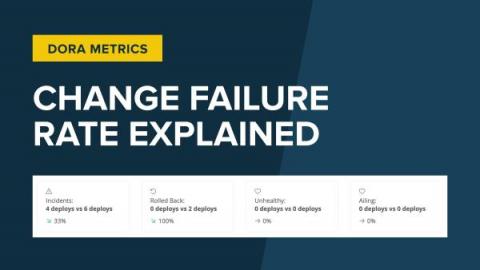

Change Failure Rate explained

This post is the third in a series of deeper dive articles discussing DORA metrics. In previous articles, we looked at: The third metric we’ll examine, Change Failure Rate, is a lagging indicator that helps teams and organizations understand the quality of software that has been shipped, providing guidance on what the team can do to improve in the future.

What the Pivot() is Going On with the MQTT Plugin?

The MQTT Consumer Plugin is one of our most widely used input plugins for Telegraf. If you need a little bit of background, then I highly recommend checking out the following: I plan to release an MQTT best practices blog soon, but we thought this plugin partnership was too good not to talk about now.

PostgreSQL Logging Configuration Explained: How to Enable Database Logs

PostgreSQL is an open-source relational database management system that’s been utilized in continuous development and production for 30 years now. Nearly all the big tech companies use PostgreSQL, as it is one of the most reliable, battle-tested relational database systems today. PostgreSQL is a critical point in your infrastructure, as it stores all of your data. This makes visibility mandatory, which in turn means you have to understand how logging works in PostgreSQL.

Django Performance Improvements - Part 2: Code Optimization

The following guest post addresses how to improve your services’s performance with Sentry and other application profilers for Python. Check out this post to learn more about application profiling and Sentry’s upcoming mobile application profiling offering. We’re making intentional investments in performance monitoring to make sure we give you all the context to help you solve what’s urgent faster.=

The Cribl Packs Dispensary - A Place to Share and Care

Building Packs is good. Sharing Packs is better! The Cribl Pack Dispensary is the go-to place to find, install and share Cribl Packs. What are Packs? A Cribl Pack is a collection of pre-built routes, pipelines, data samples, and knowledge objects. Packs enable sharing of best-practice configurations that route, shape, reduce and enrich the log source, Palo Alto Networks logs for example. And it’s the quickest, easiest way to get started with Stream and Edge supports Packs too.

Regex 101 for Network Admins

Regex—short for regular expressions—is a way to describe a search pattern. They can be used to find a text pattern or string (character sequence) within a larger body of text, such as a sentence or paragraph, but even entire documents and databases. They can be used to quickly find specific text in a text document like a configuration file for a network device. Need to know what IP addresses a device has? What VLANs are on a switch? What devices are using a deprecated DNS server?

The case for EDR vs Antivirus: Three reasons to step up your game

Over the past couple of years, we’ve witnessed a rapid adoption of endpoint detection and response (EDR) in the MSP space. An increasing number of managed service providers are choosing to leave behind legacy antivirus (AV) solutions in favor of EDR security. The differences between the core functions of AV and EDR are easy to understand and many see EDR as an obvious choice. However, some still believe that AV is enough because the customers they support have a low risk profile.

How Long Does It Take to Notice a Ransomware Attack?

Ransomware was, once again, the top cyberattack type of 2021. It has been at the top of the threats list for three years in a row. Experts estimated that a ransomware attack occurred every 11 seconds last year. The average cost of ransomware recovery was estimated to be $1.85 million. These statistics explain why some have proclaimed ransomware to be a modern threat to public safety. In this blog, we’ll demystify ransomware and answer some key questions pertaining to it.