Operations | Monitoring | ITSM | DevOps | Cloud

The latest News and Information on Cloud monitoring, security and related technologies.

Featured Post

Monitoring CloudNativePG: What Changes When the Operator Owns Your Logs

Postgres operators like CloudNativePG (CNPG) have lowered the threshold for running highly available Postgres clusters on Kubernetes. Failover, replicas, backups, and rolling upgrades are handled by the operator, along with helpful niceties like automatic configuration of essential extensions. A few changes to a YAML manifest can provide a lot of value very quickly.
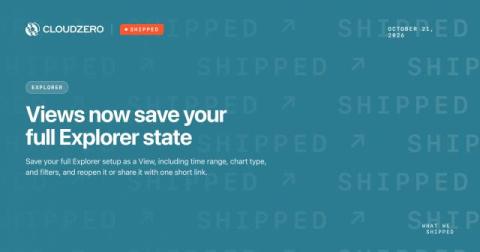
Shipped: Views now save your full Explorer state

Many CloudZero users ask the same few questions. What did my team spend this month? How is our AI spend trending over the last 30 days? What does one MCP tool call cost? Now you can save the exact Explorer setup behind each answer as a View and get back to it instantly. It’s not just filters and grouping anymore, but the full picture. You can share a link with a teammate or finance and they see the same View, filtered to the spend their role allows.

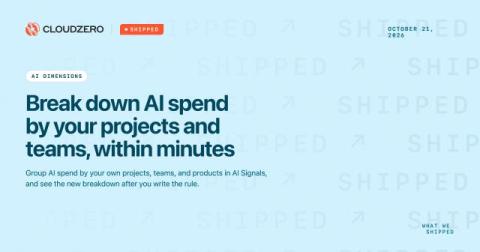
Shipped: Break down AI spend by your projects and teams, within minutes

Your company talks about AI spend in its own terms, like projects, teams, and products. Now AI Signals can show AI spend in those terms, too. Write a CostFormation rule in CloudZero that groups AI spend by categories you care about, and the new breakdown appears in AI Signals the same day you decide to track it. There’s no waiting for a full processing cycle.

Building a resource optimization agent with Kubex: Patterns

The rise of large-language models (LLMs) that can understand and create text, and reason about problems has opened the door for software agents that use the reasoning power of LLMs to interact with the wider world and solve problems. At Kubex, our bread and butter is compute and GPU resource optimization, so it’s natural for us to ask how agents could help our customers more effectively optimize their resources.

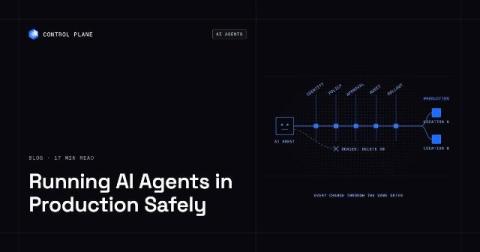
How to Let AI Agents Operate Production Infrastructure Safely

Yes, it can be safe to let an AI agent change production infrastructure, if the agent works through the same controls you would demand of a new engineer: scoped permissions, short-lived credentials, a tamper-proof audit trail, changes that roll out gradually behind health checks, and a fast rollback. The infrastructure also has to be built so that one bad change cannot take everything down.

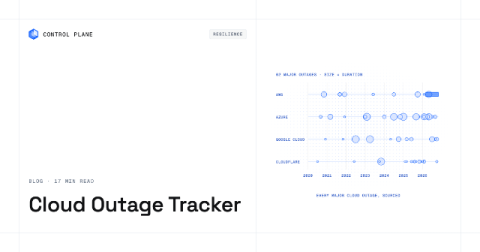
Cloud Outage Tracker: Major AWS, Azure, Google Cloud, and Cloudflare Outages Since 2020

Last updated: October 21, 2026. This tracker lists every major AWS, Microsoft Azure, Google Cloud, and Cloudflare outage since January 2020, with each provider’s own stated duration, root cause, and source. It covers 62 major incidents. The median outage lasted 6h 12m, and the most common cause was a configuration or deployment change (20 of 62, 32%), not hardware failure. We add new incidents as providers publish their post-incident reports. Control Plane publishes this tracker.

GCP Out of Capacity? How to Offload Workloads to AWS Without Running a Second Platform

Google says it is compute constrained, and GKE teams now hit ZONE_RESOURCE_POOL_EXHAUSTED on CPU machine families, not only GPUs. Here is what the error means, what Google recommends, what AWS can and cannot offer, and how to offload workloads from GCP to AWS with one platform instead of two. Romaric founded Qovery to make Kubernetes accessible to every engineering team. He writes about platform strategy, developer experience, and the future of cloud infrastructure.

How to Ensure Reliability of Data in the Cloud

The reliability of data is crucial when managing files in the cloud, especially for businesses, enterprises, and even the data reliability of your own personal files. In this article, we’ll cover everything about data reliability: what it is, why it’s important, assessing the reliability of data, and cloud storage solutions to keep your data protected, accurate, and complete.

Cloud Monitoring and Incident Response: A Guide to AWS, Azure, and Google Cloud

Effective cloud monitoring and incident response starts with understanding service health, collecting useful diagnostic data, and establishing a clear process for investigating and resolving problems. Whether you use AWS, Azure, Google Cloud, or several providers, the goal is to understand how your systems are performing and take action when reliability is at risk. A dashboard showing healthy virtual machines does not necessarily mean customers can complete a transaction.

ChatGPT Enterprise pricing in 2026: seat costs, minimums, and the new token rate card

ChatGPT Enterprise has no public list price. Reported 2026 contracts average about $60 per user per month within a $45 to $75 range, with 150-seat minimums and annual prepayment, putting the floor near $108,000 a year. Newer eligible agreements add usage-based billing under OpenAI's published token rate card.