Operations | Monitoring | ITSM | DevOps | Cloud

The latest News and Information on Containers, Kubernetes, Docker and related technologies.

K3s vs. Talos Linux: What's the difference

Kubernetes has become the go-to container orchestration system for many organizations. But managing Kubernetes clusters can take time and effort, especially for smaller teams or organizations with limited resources. This is where focused Kubernetes distributions like K3s and Talos Linux come in. They offer simplified and streamlined versions of Kubernetes, making it easier to deploy and manage clusters. This blog will introduce you to K3s and Talos Linux and compare their features and capabilities.

How To: Kubernetes Inventory Monitoring with DX UIM

Learn how to install and configure new monitoring solution to discover, dashboard and monitor your enterprise Kubernetes deployment using DX Unified Infrastructure Management. DX UIM continues to expand its coverage of new-age technologies across hybrid, multi-cloud environments to provide full-stack observability from a single pane of glass.

Sysdig Validated as AWS CloudOps Competency Launch Partner

This week AWS unveiled its new Cloud Operations Competency–aka the CloudOps Competency–designed to recognize qualified partners who help cloud customers build and manage hybrid cloud environments securely and efficiently. Sysdig is a launch partner and is now validated for the AWS CloudOps Competency in Compliance and Auditing, as well as Monitoring and Observability categories.

Why using the "one Docker image to rule them all" is probably a terrible idea.

Dan's last tutorial "Learn how to make the LAST Docker image you'll ever need" was a very successful April Fools joke. Perhaps too successful. In this video Dan does the tutorial in reverse and explains exactly why "one Docker image to rule them all" is probably a terrible idea.

Kubernetes 1.27 - What's new?

This release brings 60 enhancements, way up from the 37 enhancements in Kubernetes 1.26 and the 40 in Kubernetes 1.25. Of those 60 enhancements, 12 are graduating to Stable, 29 are existing features that keep improving, 18 are completely new, and one is a deprecated feature. Watch out for all the deprecations and removals in this version! The main highlight of this release is actually outside Kubernetes.

eBPF Explained: Why it's Important for Observability

eBPF is a powerful technical framework to see every interaction between an application and the Linux kernel it relies on. eBPF allows us to get granular visibility into network activity, resource utilization, file access, and much more. It has become a primary method for observability of our applications on premises and in the cloud. In this post, we’ll explore in-depth how eBPF works, its use cases, and how we can use it today specifically for container monitoring.

New DKP Gov Kubernetes Management Platform Sets the Government Standard

D2iQ is excited to announce the introduction of DKP Gov, a new solution optimized for the government sector. DKP Gov addresses the needs of government military and civilian agencies that are under continual pressure to innovate and adopt new technologies to keep pace with technology advances and gain strategic and tactical advantages.

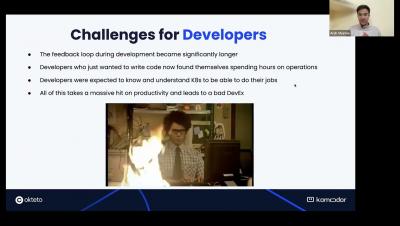
Making Kubernetes Dev-Friendly with Komodor & Okteto

Kubernetes has become the software world’s infrastructure, leading to significant changes in application architecture and packaging. Despite the introduction of new technologies and practices, they have not kept pace with the rapid growth of the K8s ecosystem. As a result, developers who once solely focused on coding are now spending hours on operations, leading to a longer feedback loop during development. They’re expected to have an understanding of Kubernetes in order to do their jobs, causing a significant drop in productivity and leading to a poor dev experience.