Micro Lesson: Creating Ingest Budgets
This video shows you how to create an ingest budget using Sumo Logic.


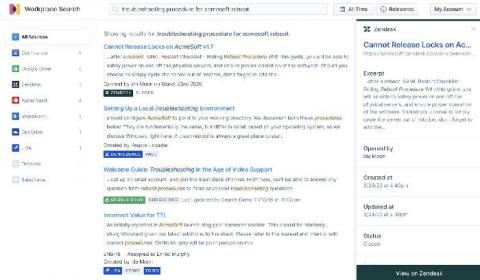
We’re excited to announce that Zendesk is now available as a pre-built content source, along with a host of others, as part of the Workplace Search application. With more than 130,000 customers in 30 countries, Zendesk has become one of the de facto customer service platforms in the world. Each day, millions of users interact with support agents via the cloud-based tool regardless of the support channel they choose.
With Elasticsearch machine learning one can build regression and classification models for data analysis and inference. Accurate prediction models are often too complex to understand simply by looking at their definition. Using feature importance, introduced in Elastic Stack 7.6, we can now interpret and validate such models.
In these times of remote teamwork, the pressure on IT teams is at its peak. So how can you ensure teams function well and conditions are good when working remotely? How do you ensure that the IT Ops teams can support the business as per usual? VPN, office suite, critical applications, videoconference, etc. The list of priorities change, new business apps need to be added while your kids and their endless energy become your face to face office colleagues. :)
On Wednesday, March 25th, we launched our Splunk for CMMC Solution with a webinar presentation to a diverse set of defense industrial base (DIB) participants and partners. As I discussed during the launch event, the Splunk for CMMC Solution provides significant out-of-the-box capabilities to accelerate organizations’ journeys to meet, monitor, track, and mature the cybersecurity practices required by the Cybersecurity Maturity Model Certification (CMMC).
As Washington and the nation reel from the spread of COVID-19, public servants across the country are quickly adapting to the “new normal.” As described in OMB’s March 23rd memo to agency and department heads, harnessing technology to support mission continuity should be a priority.
Wherever people encounter a search bar — whether on Google, phone apps, or while shopping online — they're conditioned to expect search experiences that deliver fast and relevant results. With this ever-evolving expectation in mind, millions of developers and organizations have chosen Elasticsearch for building powerful content discovery experiences over the years, to the great delight of their audience and user base.