Operations | Monitoring | ITSM | DevOps | Cloud

The latest News and Information on Distributed Tracing and related technologies.

Understanding Traces and Spans: Span Filtering With ObserveNow and Grafana 10.4

ObserveNow, the leading open source-based observability stack, has recently enhanced its capabilities with the introduction of Span Filtering – a key feature in its latest upgrade to Grafana 10.4. This advancement significantly improves the platform’s ability to dissect and analyze traces, which are crucial for understanding the behavior and performance of distributed systems.

Free the data: Why US federal agencies should standardize on OpenTelemetry

In today's digital age, data is the lifeblood of modern organizations — and the US government is no exception. As agencies grapple with the ever-increasing volume and complexity of data, it is imperative to adopt a standardized approach to monitoring, analyzing, and understanding the behavior of complex IT systems. This is where OpenTelemetry, an open-source observability framework, comes into play.

Unify your OpenTelemetry and Datadog experience with the embedded OTel Collector in the Agent

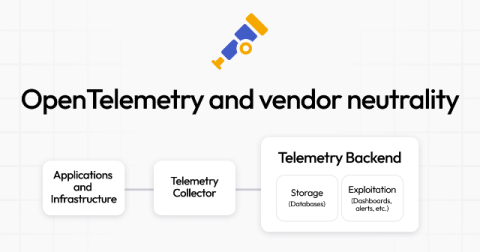
OpenTelemetry (OTel) is an open source, vendor-neutral observability solution that consists of a suite of components—including APIs, SDKs, and the OTel Collector—that allow teams to monitor their applications and services in a standardized format. OTel defines this data via the OpenTelemetry Protocol (OTLP), a standard for the encoding and transfer of telemetry data that organizations can use to collect, process, and export telemetry and route it to observability backends, such as Datadog.

OpenTelemetry Best Practices #3: Data Prep and Cleansing

Having telemetry is all well and good—amazing, in fact. It’s easy to do: add some OpenTelemetry auto-instrumentation libraries to your stack and they’ll fill your disks with data pretty quickly. However, having good telemetry data—data that’s curated into being useful—is something that is both cost-effective and represents good value.

Shorten your feedback loop: Java observability with OpenTelemetry, Grafana Cloud, and Digma.ai

Ron Dover is CTO and co-founder of Digma.ai, an IDE plugin for code runtime AI analysis to help accelerate development in complex code bases. Ron is a big believer in evidence-based development and a proponent of continuous feedback in all aspects of software engineering. Traditionally, software developers have relied on simple logs to understand code execution and troubleshoot issues.

Mastering Telemetry Pipelines: Driving Compliance and Data Optimization

I had the opportunity to present with Michael Fratto, Senior Research Analyst at S&P Global Market Intelligence, at a virtual event hosted by Redmond. We discussed how telemetry pipelines are critical in controlling telemetry data (logs, metrics, events, and traces). Mike shared excellent insights from his recent research survey that discussed the proliferation of observability tools in enterprises and the challenges organizations face in managing those tools. ‍

Tracing: Frontend issues with backend solutions

Frontend issues that affect your users are often triggered by backend problems. Join us in this workshop so you can learn how to identify the issues causing your poor Core Web Vitals. Then, discover how to trace issues to slow database queries or the dreaded server-side request waterfall. In this session you’ll learn how to: Discover common sources for poor web vitals Setup tracing with Sentry Trace issues through your stack to the code-level with Sentry.

Monitoring AWS Lambda Node.js Functions with OpenTelemetry

When deploying a Node.js function in the cloud, you might initially think of traditional methods involving web servers and other infrastructure. However, if your application suddenly faces a surge in traffic—thousands or even millions of requests—it could crash if it's unable to handle the load. This is where AWS Lambda shines. AWS Lambda allows developers to run code without provisioning or managing servers.

How to use OpenTelemetry resource attributes and Grafana Cloud Application Observability to accelerate root cause analysis

Let’s imagine a scenario: you use OpenTelemetry, and your observability backend runs on several hosts. You collect data on application latency, and notice a recent increase that you want to investigate. But how will you know which host caused the degradation? This is exactly where OpenTelmetry resources come in. In the context of OpenTelemetry, a resource represents the entity producing the telemetry data, such as a container, host, process, service, or operating system.