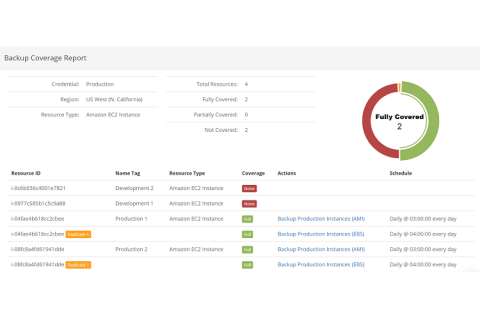
Today we’re happy to announce two new reports available to Skeddly users: Backup Coverage Report, Start/Stop Coverage Report. Both of these reports will cross-reference resources in your AWS account against actions in your Skeddly account to determine how “covered” you are.
As organizations scale and grow, teams begin to emerge with areas of specialization and ownership. Dependencies develop, with individuals and teams acting as service providers to other functional areas.
One of the cornerstones of a successful business in today’s digital environment is ensuring that web application performance is user-friendly and runs smoothly. A well-oiled website and its applications represent the face of a company, and in an ideal scenario, they serve as a mark of reliability, innovation, and progress.
Over the past few weeks we’ve been looking at feature requests on our Page Speed monitoring feature, and today we’ve released the next phase which introduces a wide range of improvement and new functionality.
Today, we released version 2.0 of the Skylight Agent. 2.0 doesn't introduce any new APIs, but we did rewrite the SQL Lexer to support more varieties of queries. We also spent a lot of time on internal refactoring and improved our error logging. Since we follow semantic versioning, we also took the opportunity to drop support for some older dependencies and environments. Read on for more information about upgrading as well as some technical details on our internal changes.
We’ve added a new feature we think you’ll want to hear about—Single Sign-on. Uptrends is now compatible with Single Sign-on. Single Sign-on (SSO) is a great way to easily manage user accounts, improve productivity, and improve security, and now you can use SSO with Uptrends.
In part one of the OpenTracing blog series we provided a good OpenTracing overview, explaining what OpenTracing is and does, how it works and what it aims to achieve. One of the key aspects of OpenTracing is that it is vendor neutral, and also that OpenTracing is just a specification. In order to instrument an application via OpenTracing API, it’s necessary to have an OpenTracing-compatible tracer correctly deployed and listening for incoming span requests.