Operations | Monitoring | ITSM | DevOps | Cloud

How to correlate logs and metrics with the Linux Node integration for Grafana Cloud

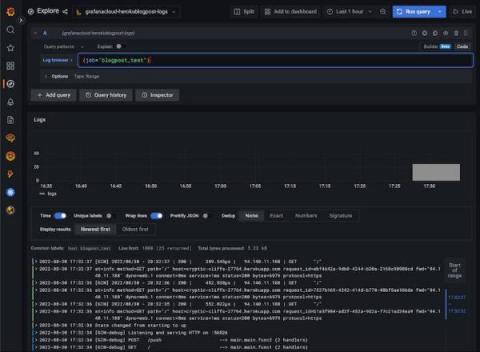
We are pleased to announce that an upgraded version of the Linux Node integration is available in Grafana Cloud, including the capability to visualize logs that are correlated with previously existing metrics. It also includes a new pre-configured dashboard based on the USE method, which focuses on showing resources utilization, saturation, and errors.

All things logs: best practices for logging and Grafana Loki

What’s the saddest log line in the multiverse? A log line without context. That’s according to Grafana Labs software engineer and Grafana Loki tech lead Ed Welch, who joined Grafana Labs VP of Culture Matt Toback and Engineering Director Mat Ryer for the latest episode of “Grafana’s Big Tent," our new podcast about people, community, tech, and tools around observability.

How the growing Grafana Observability team restructured themselves successfully

Over the past year, Grafana Labs has grown from 300 to 700 Grafanistas. Moving forward, we expect to continue to maintain a high rate of change, and to sustain that, we need to ensure there is flexibility in how our teams* are set up. The majority of our Engineering squads have changed in size and structure — and the same goes for the Grafana Observability team, where I work.

10 things you didn't know about LogQL

For this edition of my ongoing Grafana Loki how-to series, I wanted to offer up some helpful — and perhaps surprising — facts about using LogQL, Loki’s query language. In case you’re new to Grafana Loki, it’s a log aggregation system created in 2018, and the Loki team has worked with the community ever since to introduce new features and make it easier to deploy.

An introduction to trace sampling with Grafana Tempo and Grafana Agent

Greetings friends, one and all! Over here on the Field Engineering team, we’re often asked about tracing. Two questions that come up frequently: Do I need to sample my traces? and How do I sample my traces? The folks asking are usually using tracing stores where it’s simply not possible to store all of the traces being generated. Those are great questions and the answers depend on a few different factors.

How to collect Prometheus metrics with the OpenTelemetry Collector and Grafana

OpenTelemetry is a set of APIs, SDKs, tooling, and integrations that are designed for the creation and management of telemetry data such as traces, metrics, and logs. One of the main components of OpenTelemetry, or OTel for short, is the OpenTelemetry Collector. The OpenTelemetry Collector, or Otel Collector, is a vendor-agnostic proxy that can receive, process, and export telemetry data.

New in Grafana 8.5: How to jump from traces to Splunk logs

The recent release of Grafana 8.5 marks the start of enabling the jump from traces directly to Splunk logs. It’s a big leap that now allows you to draw a straight line between your traces — whether they are coming from Tempo, Zipkin, or Jaeger — to even more third-party logging data, all from the comfort of your traces view. Previously, the Grafana trace to logs enablement included only Loki logs.

Monitoring next-generation maritime vessels at Royal IHC with Grafana Cloud

With a storied past in Dutch maritime history, Royal IHC is known for delivering reliable, integrated solutions for their customers. These clients rely on sophisticated vessels to create new ports, maintain navigable waters, clean up pollution, and slow shoreline erosion through the process of dredging, which involves removing sediment and debris from the water.

Introducing the official ClickHouse plugin for Grafana

We are delighted to introduce the new first-party ClickHouse plugin for Grafana, developed by Grafana in collaboration with ClickHouse. Grafana is committed to continuing our partnership and maintaining this plugin, and we’re excited to add more features and to grow with ClickHouse. But why Grafana + ClickHouse?

How to capture Spring Boot metrics with the OpenTelemetry Java Instrumentation Agent

In a previous blog post, Adam Quan presented a great introduction to setting up observability for a Spring Boot application. For metrics, Adam used the Prometheus Java Client library and showed how to link metrics and traces using exemplars. However, the Prometheus Java Client library is not the only way to get metrics out of a Spring Boot app. One alternative is to use the OpenTelemetry Java instrumentation agent for exposing Spring’s metrics directly in OpenTelemetry format.