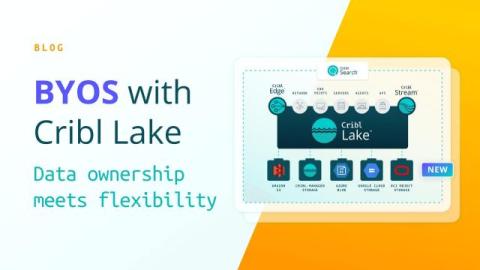
Today, more than ever, organizations face a difficult balancing act: how to keep sensitive data fully under their control while still making it accessible and usable so teams can unlock the value and insights they need. Industries such as financial services, healthcare, and government agencies often must comply with strict regulations that require data to remain in environments they directly own and manage.
Way back in 2009, when I was serving as a second lieutenant in the U.S. Army, I worked in a network operations center for a deployed Army unit. Our mission was to provide network connectivity across central and northern Iraq. Our observability tools were incredibly limited. We had a network map that would turn nodes and network links red, yellow, and green when they were up or down. We had to write down in a physical logbook any status changes and what we did about them.
As a Co-founder and CPO at Cribl, I'm genuinely stoked that our new federal suite, Cribl.Cloud Government, has achieved an “In Process” designation under the Federal Risk and Authorization Management Program (FedRAMP). This isn’t any old milestone. We’re bringing all of Cribl’s kickass capabilities to government agencies, even those that require the strictest compliance and security standards. Because, who doesn’t love a good set of rules?
Modern IT environments are hybrid, distributed, and constantly growing. To keep them reliable, organizations rely on monitoring that scales, automates, and integrates seamlessly into existing workflows. We collected 24 Icinga customer stories from industries including finance, telecom, manufacturing, and public services. What unites them is the choice of Icinga as a flexible and cost-efficient alternative to proprietary monitoring tools.
Until recently, Grafana Mimir — our open source, horizontally scalable, multi-tenant time series database (TSDB) — has exclusively used Prometheus’ PromQL engine to evaluate queries. While the PromQL engine works great, it sometimes needs a lot of memory to run, specifically in the Mimir querier component. To address this memory consumption issue, we recently introduced Mimir Query Engine (MQE).
Modern applications don’t process everything inside the request/response path. To keep APIs responsive, time-consuming work like image resizing, payment processing, or data syncs is moved into background queues. Workers then pick up these asynchronous jobs and run them outside the main thread. Asynchronous job monitoring is the practice of tracking these background tasks: Without this visibility, background workers become a blind spot.
Today, we have launched our MCP server. MCP (Model Context Protocol) is a standardized way for AI models to connect with external data sources and tools. If you use a tool like Claude Code, then this is how you can connect Oh Dear to it (you can create an API token in your account settings)
A few weeks ago, we massively improved the performance of the dashboard & website by optimizing some of our SQL queries. In this post, we'll share how we identified the queries that needed work. In the next post, we'll explore how we fixed each of them. We'll cover the basics and gradually work our way up to the more advanced/complex ways of identifying slow queries. In this post, you'll see: Let's go!