Operations | Monitoring | ITSM | DevOps | Cloud

Sponsored Post

Microsoft Teams Optimization for a Remote Workforce

Microsoft Teams is everywhere. Not surprisingly, during the pandemic, the number of daily active users for Teams increased to 75 million in 2020. More and more people are WFH and companies are becoming virtual. Personal meetings are fading now, and Teams poises to become the next best collaboration tool. According to a Riverbed study, 64% of US employees are now working from home because of the Covid pandemic. In turn, Microsoft Teams optimization has become a critical topic for Operations and Network personnel.

How To Prepare Your Business For High-Frequency Change

"The future-ready enterprise can only be understood as an ecosystem of interdependent components." In our latest webinar, Applied Futurist Tom Cheesewright and Console Connect’s Neil Templeton dug deeper into the findings of our ‘Building Tomorrow’s Interconnected Enterprise’ report, and highlighted how rapid technological change is disrupting traditional business models.

How to see all your Azure VM Snapshots

Snapshots in Azure is a nice feature that allows you to take a read-only, “point in time” snapshot of a Virtual Machine’s disk. You can take a snapshot of a VM’s OS or data disk. You can use this snapshot to revert the VM to a point in time before an event occurred, or you installed something that didn’t go quite right.

Why to Use Git Instead of "TFS" (TFVC)

One question we frequently hear from customers using the Microsoft stack is, “should I use Git or TFS?” The question requires a little decoding due to the way that Microsoft has shifted their brands over time. Here’s some background. Many people still refer to this as “TFS,” regardless of the version they are using. TFVC used to be the default type of repo for TFS projects.

Never Discount the Power of Convenience

Whenever I look broadly at my career in telecom, one area that always amuses me is the extent to which our collective business enjoys its peculiarities. Sort of like our own secret handshake society full of unique terms and abbreviations like AIN & ANI, DDI and CLID or CLECs and POTS. After all, the Bell System used to formally publish a list of abbreviations and acronyms. Maybe it is just in our DNA?

Understanding the consumer side of Azure Event Hubs (Checkpoint, InitialOffsetProvider, EventProcessorHost)

Azure Event Hubs are cloud-scale telemetry ingestion from websites, apps, and devices. Because of the tremendous event handling capacities, IoT architectures also consume the Azure Event Hubs. Thus, we talk about handling millions of events per second. With the implementation of multiple partition architecture behind the scenes, Azure Event Hubs are highly scalable to receive events from hundreds of sources.

Dashboard anything for free: SquaredUp Dashboard Server Public preview available now

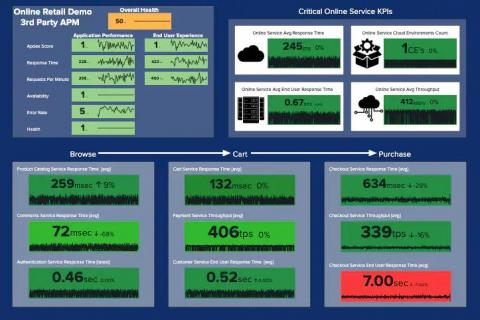
How would your IT team be transformed if you could dashboard anything, for free? If you’re an IT pro and want an enterprise dashboarding tool that’s quick to implement, easy to set up, and effortless to maintain, you need SquaredUp Dashboard Server! The public preview of SquaredUp Dashboard Server just went live! Dashboard Server functions independently of SCOM and Azure and introduces a new PowerShell tile to take dashboarding a big step further. Now you can dashboard virtually any data.

Logging Errors in Web Workers

Release 3.8.0 of the TrackJS browser agent added support for Web Workers, which adds some awesome new observability to the background tasks of your web applications. Many development teams have adopted Web Workers to their web applications to add offline support, caching, or to process heavy tasks. Workers allow web apps to feel faster by removing work from the user interface thread.

Expert Guide to Redis Monitoring

Redis is an open source. in-memory data structure store with blazing performance that’s used as a database, cache, and message broker. Redis is licensed under BSD (Berkeley Source Distribution), which means it can be used for free with some minimum use restrictions. It supports a good number of abstract data structures, such as strings, maps, lists, and so on. Redis, which is used as a database to store data, is fast in performance.