Operations | Monitoring | ITSM | DevOps | Cloud

Announcing SOC 1, FedRAMP 20x Class A, PCI, and HIPAA Milestones At Harness

Explore Harness' latest compliance milestones: SOC 1, FedRAMP 20x Class A, PCI DSS, and HIPAA assessments across its platform and runtime security. Harness announced four compliance milestones: its first SOC 1 audit, FedRAMP 20x Class A certification, and first PCI DSS and HIPAA Security Rule assessments. SOC 1 and FedRAMP 20x Class A apply to the Harness Autonomous SDLC Platform. PCI DSS and HIPAA apply to the Runtime Protection Agent.

AI cost per customer: measure it and protect your margins

AI cost per customer is each customer's attributed share of your AI spend: API tokens, inference infrastructure, and per-seat AI tools, measured against that customer's revenue. It matters because AI usage is wildly uneven across customers, so healthy blended margins can hide individual customers you serve at a loss. It's cost to serve, not acquisition cost. Cost per customer is the metric CloudZero was built around.

Shipped: Log and track Insights from your AI assistant

Insights are how your team tracks interesting observations, analysis and optimization work in CloudZero. Each one records the opportunity and its status, so the work gets sized, assigned, and closed out. Teams now do a lot of this work in an AI assistant. For example, you can ask Claude which instances sat idle last month, and it will tell you. But if you have to switch to CloudZero and fill out a form to log that finding, some findings won’t get logged.

Five things you can do with Sentry's Agent Tracing

AI-powered apps are hard to debug without observability. From one run to another, AI produces different results, goes down different paths, and you’re none the wiser as to why it’s happening. Agent Tracing bridges the gap between prompt, tool calls and final output, all within the context of your app. If things break (it always does at some point, we know from experience), you get everything in one complete trace.

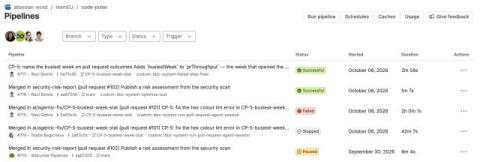
A fresh look for Bitbucket Pipelines

We’re refreshing the Bitbucket Pipelines experience to make it easier to read logs, find the steps you need, and navigate a pipeline run. The update focuses on the Pipelines list and Pipeline result pages. This is a visual refresh only. Your pipeline configurations, builds, data, runners, variables, deployments, and integrations stay as they are. It’s the same Bitbucket Pipelines underneath, with a cleaner, more focused view.

CA distrust wargame: moving every certificate in 10 minutes

Last week, dozens of schools found out their certificate authority was being distrusted and they needed to replace all of their certificates in a few days. We wanted to know how we’d handle it if our own CA went away, and how long it would take. So we tried it with one of our other products. It has 6 certificates from Let’s Encrypt, deploying to 18 targets across Windows IIS, Linux nginx, Elasticsearch, and a mail server. Then we wargamed it: “Let’s Encrypt is being distrusted.

The Hard Part of Incident Remediation Is Knowing When to Act

A critical application slows overnight. Monitoring identifies an unhealthy component, and an engineer finds a familiar remedy: restart a service. The command takes seconds. Determining whether the restart will restore the application or disrupt another dependency takes far longer. That is the real challenge in enterprise incident remediation. Most IT teams already know how to automate a task.