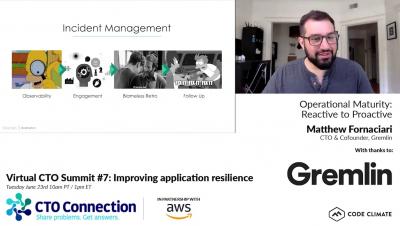
Gremlin CTO Matthew Fornaciari at the Virtual CTO Summit
In this talk, Gremlin CTO Matthew Fornaciari discusses moving from reactive to proactive operations.


The latest News and Information on DevOps, CI/CD, Automation and related technologies.
Your team is practicing DevOps and you’re delivering some flavor of Continuous Delivery. You’re deploying anywhere from three times a week to twenty times a day. You are moving fast! At that speed, how do you know if you are moving things in the right direction? Hopefully, your team has defined some key SLIs that define your application’s health.
Over the past few years, we’ve seen an almost obsession with developing and adopting CI/CD tools throughout the DevOps community. There are thousands of “how-to’s”, “top x tools”, and “tool x vs tool y” type articles, and it has gotten to the point where it’s quite difficult to figure out how and which one to pick as your own.
IT is advancing blazingly fast. To keep up with architectural changes and hybrid environments, it’s more important than ever to maintain efficient infrastructure monitoring and troubleshooting. Adding to the complexity is the increase of distributed systems, comprised of many components and services.
In Kubernetes, Ingress objects define rules for how to route a client’s request to a specific service running inside your cluster. These rules can take into account the unique aspects of an incoming HTTP message, including its Host header and the URL path, allowing you to send traffic to one service or another using data discovered in the request itself. That means you can use Ingress objects to define routing for many different applications.
At Elastic, we believe in the power of open source and understand the importance of community. By putting the community first, we ensure that we create the best possible product for our users. With Elastic Security, two of our core objectives are to stop threats at scale and arm every analyst. Today, we’re opening up a new GitHub repository, elastic/detection-rules, to work alongside the security community, stopping threats at a greater scale.