Operations | Monitoring | ITSM | DevOps | Cloud

Define user actions on your web app with visual labeling in Product Analytics

Adding or renaming a product event has traditionally meant creating an engineering ticket. Datadog Product Analytics uses the same SDKs and configuration as Real User Monitoring (RUM), and those SDKs autocapture actions such as clicks and taps. But an automatically generated action name describes the element rather than the user intent behind it.
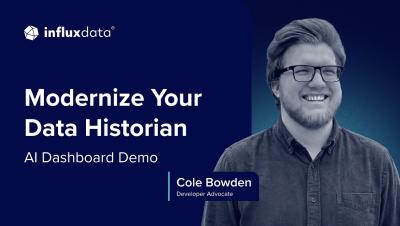

Modernize Your Data Historian with InfluxDB

In this video, Dev Advocate Cole Bowden walks you through where traditional data historians fail, and why a dedicated time series database like InfluxDB can streamline your operations. With an AI-powered demo showcasing an automative plant's data, you'll see the value of InfluxDB and where it can power insights that Data Historians can't handle on their own.

Solving AI Latency and Cost Problems with Valkey - Aiven Webinar

LLM providers charge you for caching, and they do it on their terms. You can run it yourself for a fraction of the cost. In this Aiven webinar, Jay Miller (Staff Developer Advocate) shows how to use semantic caching and semantic routing on Valkey to cut prompt costs + latency. You'll see a working demo, "Template Scout", that searches GitHub for deployable repos and picks the cheapest model that can answer each question.

Q3 2026 Recap: Up to 4x Faster Single-Series Queries, Distributed Compaction, and Telegraf Controller High Availability

Q3 was a packed quarter, with releases across InfluxDB, Telegraf, and Amazon Timestream for InfluxDB that help deployments and fleets grow without slowing down. InfluxDB 3.11 brought performance improvements for heavier, more complex workloads to GA in InfluxDB 3 Enterprise. InfluxDB 3.12 followed with roughly 3x faster bulk imports, distributed compaction in beta, per-database schema enforcement, and generally available role-based access control.

PostgreSQL MCP: Manage Postgres From Your AI Assistant

TL;DR Most of the time we understand the tasks we're working on, but inevitably something comes up that we don't know much about, and we need just enough skill to cope. That used to mean reading paper documentation, then searching vendor sites and the web. Now it tends to mean a dialog with an LLM that has already ingested the documentation we don't have time to find and read. That's only half the problem, though.

Why Automotive Manufacturers Are Augmenting Data Historians, Not Replacing Them

Summary Automotive manufacturers face rising costs and scaling limits with per-tag-priced data historians as sensor counts and sampling rates grow. Instead of rip-and-replace, manufacturers are augmenting traditional data historians by routing new telemetry to InfluxDB (via Telegraf or Litmus or consolidating siloed historians, while the historian continues handling SCADA and regulatory data. Table of Contents.

Your data says one thing. Your AI thinks another.

Aiven and SFEIR walk through what a governed, AI-ready foundation for product data looks like, and what it actually takes to build one. We'll be joined by Céline Thooris, Managing Director of WEnvision (SFEIR group), and Stan Dmitriev, Product Director for Aiven Context, sharing a first-hand view from the field and a concrete next step. What to expect.

Adding Search and SEO Data to Your Data-Engineering Pipeline

A company can have a mature data warehouse and still handle search data in a surprisingly improvised way. Product events arrive automatically. CRM records are synchronized. Revenue tables refresh overnight. Search rankings, keyword metrics, and backlink data, meanwhile, may still appear as exports sitting in somebody's downloads folder.

Opensearch, AI, and a Grab-bag of topics with Jay Miller and Dima Kan

Fireside chat between Jay Miller, Developer Advocate at Aiven and Dima Kan, Staff Product Manager for OpenSearch about the role of search in AI. AIVEN DATA PLATFORM The Aiven Platform is more than a collection of open source services for streaming, storing and analyzing data. The platform ensures that all services run reliably and securely in the clouds of your choice, are observable, and can easily be integrated with each other and with external 3rd party tools.