Operations | Monitoring | ITSM | DevOps | Cloud

The latest News and Information on APIs, Mobile, AI, Machine Learning, IoT, Open Source and more!

eBPF: Correlating rustls Plaintext to TCP Connections Without a File Descriptor

In Under the Hood with Go TLS and eBPF, I left socket tracking as an exercise for later. The example used bpf_get_current_pid_tgid() and explicitly excluded concurrent TLS operations. Capturing plaintext was enough for that post. With rustls, later arrived: I could read the HTTP payload perfectly and still attach it to the wrong TCP connection. That’s a frustratingly convincing failure. The request looks right. The response looks right. The application works.

How we built iOS 27 into StatusIQ: Onscreen awareness, Siri actions through Spotlight, a one-stop widget for key information, and Liquid Glass optimization

When an incident hits at 2am, every second of context switching adds risk. The latest StatusIQ iOS update is built around one principle: Get the right information and the right actions to your team faster, with less friction. With iOS 27 support now live in the StatusIQ mobile app, here's what's changed and why it matters.

First Look: Build Grafana Dashboards with AI using the MetricFire MCP Server

Get a first look at what’s coming next to the MetricFire MCP Server: AI-powered dashboard creation and management. We’re connecting the Hosted Graphite HTTP Dashboard API to our MCP Server, letting compatible AI clients work with your monitoring data and Grafana dashboards directly through an AI-assisted workflow. Soon, you’ll be able to use natural language prompts to reference metrics stored in Hosted Graphite and create, update, and manage dashboards.

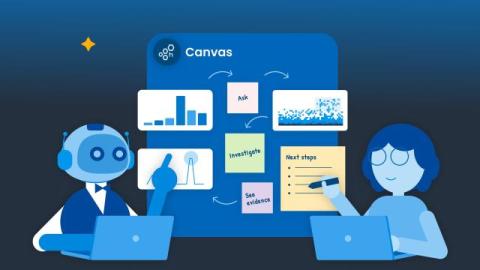
How Canvas Powers the AI Agent Development Feedback Loop

For teams building AI agents, the feedback loop should already be a familiar idea: watch how the agent behaves, find what needs improvement, ship a change, and measure the result. In theory, each turn builds on the last until the loop becomes a flywheel and your agent is getting more effective with each turn. In practice, many of us are still in reaction mode. A user reports something strange, costs spike, or an eval score drops.

The AI Economy Has a Senior Engineer Problem. Here's How to Solve It

According to a 2025 report from Ravio, entry-level hiring (especially in engineering roles) has collapsed by more than 73% due to increasing AI capabilities. That means junior developer jobs are disappearing. At the same time, demand for senior engineers keeps climbing because organizations need more people to manage and optimize their complex AI agents.

Are AI agents about to break cloud computing?

AI agents can write code and run tools on their own now. The problem is they still need somewhere to actually do it. exe.dev's David Crawshaw joins Michael Reid to break down why persistent virtual machines might become the backbone of agentic AI, and what happens to cloud economics when one person is running dozens of agents at once.

Shipped: Know what you actually pay per token on OpenAI

Picture two teams running the same million input tokens through the same model. One team’s tokens are cache hits, queued through the batch API. The other team’s are fresh, sent live. On a current-generation OpenAI model, cached input runs about a tenth the price of a fresh token, and batch processing cuts whatever’s left in half. Stack the two: at a list rate of $2 per million tokens, one team’s bill comes to 10 cents, the other’s to two dollars.

Datadog named the Company to Beat for observability platforms in 2026 Gartner AI Vendor Race report

Datadog has been named the Company to Beat for observability platforms in the August 2026 Gartner AI Vendor Race research. Datadog has also been named a Leader in the 2026 Gartner Magic Quadrant for Observability Platforms for the sixth consecutive year. We believe that these recognitions reflect what we have been building toward for more than a decade: a single platform where teams can observe, secure, and act on everything that matters across their technology stack.

The Synthetic Claims Crisis: How Generative AI Is Reshaping Insurance Fraud and Visual Verification

The insurance industry is currently facing a fundamental shift driven by rapid advancements in generative technology. Automated intake pipelines have significantly sped up processing, yet they have simultaneously exposed insurance companies to an entirely new category of financial risk. Today's generative networks and image editing tools allow anyone to craft hyper-realistic visual evidence in moments. Bad actors no longer rely solely on physical staging; they can fabricate fake vehicular accidents or digitally amplify minor home damage with incredible accuracy.

Anthropic's Fable 5 Falls Short on Enterprise Adoption

Two months ago, Claude Fable 5 launched with the kind of fanfare usually reserved for a flagship phone. Anthropic called it the most capable model on the market. The U.S. Department of Commerce briefly suspended access over export-control concerns, which only added to the buzz when it returned three weeks later. Then the spending data came in, and it told a much quieter story. According to Ramp's August AI Index, which tracked spending across 70,000 businesses, Fable 5 accounts for just 11.4% of what companies spend on Anthropic's models and only 6% of the tokens they actually use.