Operations | Monitoring | ITSM | DevOps | Cloud

Infrastructure Observability: What It Is and How It Beats Monitoring

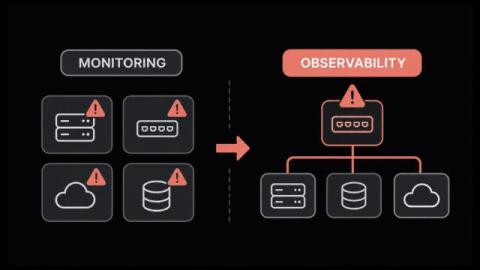
Why does an outage that triggers dozens of alerts still take hours to explain? It's a common complaint in IT operations. Each device reports its own problem, and no alert says which failure came first. Look at how infrastructure monitoring works. A server, a switch or a virtual machine gets checked against a limit someone set months ago; anything beyond that limit is for engineers to figure out, usually across separate consoles.

Three Ways to Migrate from Dropbox to OneDrive

This article offers different methods to migrate from Dropbox to OneDrive for business and personal use. We will also cover what you should consider before migrating your files to avoid data loss, and factors you should consider before transferring your files to make switching from Dropbox to OneDrive as smooth as possible.

The First Certified DEXOps Cohort: Building the Discipline Behind Better Digital Experiences

Many organizations have invested in making the employee experience of technology more visible. The next step is building the operating model needed to act on what they see. As DEX moves further into board-level conversations, this becomes more important. IT leaders need to show how the experience of technology connects to the outcomes the business cares about and create a repeatable way to improve it.

AI Agent Observability: What to Track on Every Agent Run

An agent investigating a latency alert finishes with a green status and a sensible root cause. Nothing on the dashboards looks wrong. But the run took eleven minutes instead of two, retried the same flaky metrics query six times, and cost far more than the agent’s usual run. Nobody notices until the monthly model bill arrives, or until the same flaky call starts failing outright. That’s the gap AI agent observability closes. Standard monitoring tells you the service is up.

Building AI SRE Agents, Part 4: One Agent Is a Tool. A Fleet Is a System.

Five problems that show up once many agents run in production, and the common ways to monitor, mitigate, and guard against each one. The first three parts of this series took a single AI SRE agent from a laptop to enterprise production. Part 1 built it read-only on a throwaway cluster. Part 2 moved it to the cloud and climbed the trust ladder in shadow mode. Part 3 hardened it for regulated environments with least-privilege access, audit, and a CI-gated eval pipeline.

Are Your Models Aligned With Your Work? AI Signals Reports Explained

In this video, Kaitlin Woo, Product Manager for AI Signals at CloudZero, introduces templated reports that give a quick view into AI spend in one click. The reports tie spend back to activity classification, such as feature development, bugs, and automation for developers, and let you filter to an individual person for a full breakdown of their model mix and top activities without configuring anything. Those are details a bill never shows. CloudZero gives leaders who manage an AI budget this view across all providers, so they can tell whether a heavy user’s share of spend makes sense and how to support AI adoption.

CertKit Keystore 2.0: private keys encrypted on your own hardware

When we shipped the CertKit Keystore in March, it required some admin work from you. Run it on a proper server. Encrypt your backups. Test them. The private keys were yours to protect, as plaintext keys on your disk. Keystore 2.0 makes most of that admin work easier. It’s live now, available on Enterprise plans.

Would you notice? AI assistants, MCP servers and your databases

Database professionals can use AI to improve everyday work by starting with a task they already understand, giving the assistant the context it needs, building review into the workflow and limiting what an agent can reach. The AI sessions at PASS Summit West 2026 pointed to the same lesson: the value comes from the work around the assistant, not the assistant alone.

How to keep your databases secure and under control: takeaways from PASS Summit West 2026

Database professionals can use AI to improve everyday work by starting with a task they already understand, giving the assistant the context it needs, building review into the workflow and limiting what an agent can reach. The AI sessions at PASS Summit West 2026 pointed to the same lesson: the value comes from the work around the assistant, not the assistant alone.

Express Ships a body-parser Fix for a Request DoS. Upgrade Now.

A denial-of-service bug that can take down a Node process with one crafted request is the kind of thing you want patched before you think about it again. Express just bumped body-parser to ^2.4.0, pulling in the fix for CVE-2026-111181, and the failure mode is a hard crash rather than a slow degradation. Scout Monitoring instruments Express out of the box, and a crash loop is exactly the kind of event that should show up on a dashboard the moment it starts.