Operations | Monitoring | ITSM | DevOps | Cloud


The latest News and Information on Application Performance Monitoring and related technologies.

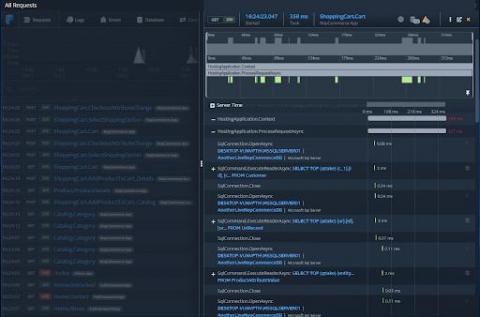
Prefix Premium - Profile, Test & Fix Code As Your Write It
Like all of us today, I’m buying more and more products and services online. But even the slightest hiccup in my digital experience might cause me to switch vendors. Multiply that risk by millions – the result of digital commerce growing at an exponential rate – and it’s easy to see how bad user experiences could literally sink a company.
End User Experience Monitoring: Why You Need It
These days, a new venture’s success begins and ends on customer experience. Due to a large number of similar digital products out there, end users will stop using a product immediately if the user experience is not seamless. Similarly, a mobile application delivering a substandard user experience (UX) will fall behind the competition. A good digital product can turn into a failure if it does not work for the end user.

Webhooks for Raygun Alerting - Create custom third-party integrations

Why You Need APM-and How it Works
There’s a lot to consider when engineering and implementing software, whether as an update patch or a newly-introduced product. End users have certain expectations when introduced to new or updated software—at the top of the list are aesthetics, ease of use, stability, and response time—the last two of which can be significantly improved when you employ application performance management or APM.
A sleek new trace filter and trace details tab, 50+ contributors in our tribe - SigNal 10

Error monitoring and exception handling in large-scale software projects
Large-scale software projects don't care how many unit tests you put into your code. Or how sophisticated your CI/CD pipeline is. Or how robustly you run blue-green deployments to ease into newly-deployed code. These projects will inevitably find themselves subjected to your users, who will uncover bugs your team didn't catch and didn't even think to test for.

A Complete Guide to Tomcat Performance Monitoring
Metrics and runtime characteristics for application server monitoring are critical for the applications running on each server. Monitoring also helps to prevent or manage possible problems promptly. Apache Tomcat is one of the most widely used servers for Java applications. JMX beans or a monitoring tool like MoSKito or JavaMelody can be used in Tomcat performance monitoring.

Datadog On Rust

Empower IT Help Desks: Deliver Business Value with IT Service Monitoring
On one of the EUC slack forums, a question was recently posted asking what are the key lessons learned in the last year and what changes organizations should investigate in the next year. The answers were revealing. Several folks pointed out that prior to the pandemic, we were operating within the comfort zone of carefully planned deployments with managed devices and managed networks.