Operations | Monitoring | ITSM | DevOps | Cloud

The latest News and Information on Cost Management and related technologies.

How To Incorporate FinOps Into The DevOps Lifecycle

FinOps, or the practice of managing a company’s cloud computing costs, and DevOps, the process of efficiently building applications in the cloud, should ideally go hand-in-hand. Engineers with a streamlined development process and a cost-conscious mindset can produce functional products with great margins and a high potential for scalability. However, incorporating FinOps into the DevOps lifecycle, and vice versa, isn’t always easy.

The 7 Best FinOps Blogs, Books, And Other Resources

There are almost as many reasons for learning FinOps practices as there are resources available to learn from. Maybe you operate a SaaS company, for example, or you're looking for a job in FinOps. The FinOps field grows in importance every time cloud services and their associated costs become more complex — which can feel like every single day. Regardless of your situation, you’ll need high-quality FinOps resources that offer up-to-date materials and in-depth information.

ElastiCache Vs. Redis: How Do They Compare?

As technology improves and customer demands change, many companies must provide fast, engaging, and secure services. Developers rely on platforms that support sub-millisecond response times to power these capabilities in their applications. Amazon ElastiCache and Redis are two of the most popular platforms for building fast, highly available, and scalable data stores.
Sponsored Post

A 7-Step Guide to IT Cost Reduction in 2023

As per the latest forecast by Gartner, worldwide IT spending is projected to amount to $4.6 trillion in 2023, up by 5.1% from 2022. The demand for IT will be strong in 2023 as enterprises launch digital business initiatives to respond to global economic challenges. In a downward economy, conventional wisdom warrants reducing costs.

4 Common Obstacles To Managing Microsoft Azure Costs (And How To Overcome Them)

Microsoft Azure was a relative latecomer to the public cloud market: AWS preempted everyone in 2006, and Google GCP came next, in 2008. By the time Azure launched in 2010, the public cloud market had already grown to more than $24 billion. Despite being third to the party, Azure had a key advantage: The Microsoft Office Suite was (and is) a go-to choice for corporate collaboration.

Boost Your Apache Impala Query Performance with Query Spotlight

Are your Apache Impala queries running slow and not achieving peak performance? Given Impala’s complexity, troubleshooting can be very difficult. Optimizing query performance is near impossible without the right tools. Good news: Pepperdata Query Spotlight now supports Apache Impala.

A comprehensive guide to cloud cost management

With 34% of cloud developers facing difficulties when calculating how much their cloud provider is going to charge them each month, it is essential to prioritize cloud cost management. This concept surrounds the process of monitoring, controlling, and optimizing an organization’s cloud service spend. By having the correct cloud cost management strategies in place, organizations are able to eliminate unnecessary expenses through optimizing resource allocation and cost-saving strategies.

Our Journey Into Cutting Kubernetes Costs by 40%

As companies start their Kubernetes and cloud-native journey, cloud infrastructures and services grow at a rapid pace. This happens all too often as organizations shift left without thorough controls, which can lead to overallocating and overspending on their Kubernetes environments. Organizations running workloads in the cloud can put budgets at risk when they lack information about key facts.

Repatriation to reduce public cloud spend - easier said than done?

Repatriation in cloud computing refers to moving workloads from the public cloud to on-premise infrastructure. Sarah Wang and Martin Casado from Andreessen Horowitz have written one of the most popular articles about repatriation: they explain the motivation with the significant cost savings possible. For software-based businesses, public cloud spend can rise to 50% of the cost of revenue (COR). Reducing these costs has the potential for significant margin increases.

Understanding Your Amazon EKS Spend

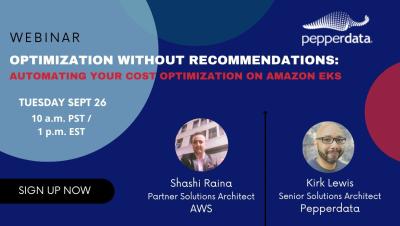
Most customers running Kubernetes clusters Amazon EKS are regularly looking for ways to better understand and control their costs. While EKS simplifies Kubernetes operations tasks, customers also want to understand the cost drivers for containerized applications running on EKS and best practices for controlling costs. Anodot has collaborated with Amazon Web Services (AWS) to address these needs and share best practices on optimizing Amazon EKS costs.