Operations | Monitoring | ITSM | DevOps | Cloud

How to boost observability ROI with continuous profiling and Grafana Drilldown

For the longest time, observability was centered around logs, metrics, and traces, but the growth of more complex systems has made continuous profiling another essential part of maintaining healthy systems. It provides insights into resource usage and latency down to the code level, delivering key insights to improve performance.

Grafana Campfire - UI Extensions: Enabling Cross-App Workflows (Grafana Community Call -Sept 2025)

In this upcoming Grafana Campfire Community Call, we will talk about the Grafana UI Extensions, where we will discuss how the Framework enables plugins to interoperate by adding links, components, or functions into defined places (extension points) in Grafana. We will talk about (but not limited to):What are UI Extensions and where you find the resourcesHow it can be leveraged to deliver fun new featuresAdding custom actions, links, and components to various parts in UI and much more.....

Lighting up your dashboards: How to visualize the CheerLights IoT project in Grafana Cloud

I recently joined the Developer Advocacy team here at Grafana Labs, and have been exploring ways to accelerate my Grafana learning journey. Like many others in the Grafana community, my introduction to the open source project happened when I needed a way to easily visualize data that resided in external databases, mostly using SQL queries.

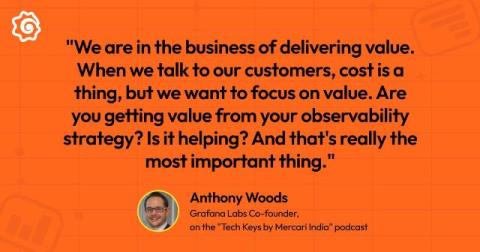
Grafana Labs Co-founder Woods: Market maturity, OpenTelemetry, and AI are reshaping observability

As organizations navigate increasingly complex tech environments, unified observability practices have become essential. That was one of the main takeaways from Grafana Labs Co-founder Anthony Woods’ recent appearance on “Tech Keys by by Mercari India,” a podcast hosted by Vaibhav Khurana, Head of Platform Engineering at Mercari India.

Infinity Data Source Now Supports Auth for Actions | Grafana 12.2

Grafana 12.2 introduces actions authentication with the Infinity data source — giving you more secure and flexible ways to trigger actions. Previously, actions were limited to browser-based HTTP requests subject to CORS. Now you can choose between browser requests or Infinity connections, leveraging preconfigured authentication settings. This update makes actions more powerful and reliable in Grafana 12.2.

Visualize Jenkins CI/CD Pipelines: Introducing the New Jenkins Data Source Plugin in Grafana 12.2

Grafana 12.2 introduces the new Jenkins data source plugin, giving you real-time insights into your Jenkins CI/CD pipelines. With easy setup, you can connect your Jenkins instance and explore two built-in dashboards: See how Jenkins data becomes instantly actionable inside Grafana.

New Grafana One-Page Report (Public Preview) | Grafana 12.2

Grafana 12.2 introduces a redesigned reporting feature, now in public preview. The new one-page report creation flow replaces the old multi-step wizard, making it easier and more intuitive to schedule and share insights. You can now: Check out how the new reporting experience simplifies sharing data in Grafana 12.2.

Create New Alert Rules Without PromQL Queries in Grafana 12.2 | Metrics Drilldown

Grafana 12.2 makes alert creation simpler by integrating the Metrics Drilldown app with the Alert Rule Query Editor. Instead of writing PromQL from scratch, you can now use a queryless workflow: explore metrics, add labels, and generate queries directly from Drilldown. This helps teams move faster and makes alerting more accessible for those new to PromQL.

Grafana 12.2 release: LLM-powered SQL expressions, updates to canvas and table visualizations, simplified reporting, and more

Grafana 12.2 has arrived, delivering new features to help you and your team move from data to decisions faster than ever. Grafana 12.2: Download now! Below are just some of the highlights from the latest Grafana release.

Mute timing vs. silences in Grafana Alerting: How to pick the best fit for your use case

Have you ever been in a situation where know your team is going to run their weekly maintenance window and you silence your notifications to prevent a flood of false positives from pinging your inbox? If you are associated with a team that uses any type of alert system, you know how easily alert fatigue can happen. The incessant and unpredictable (or even, at times, predictable) pings, emails, and notification alerts can drive even the most serene worker totally batty.

How to perform real-time DNS monitoring in Grafana Cloud

When DNS or domain name server resolution processes fail, or become sluggish, users can experience timeouts, connection errors, and degraded performance — often without clear indication of the root cause. This is where DNS checks in Grafana Cloud Synthetic Monitoring come in, allowing you proactively monitor domain name resolution, verify that domains resolve to the correct IP address, and even measure how quickly that resolution occurs.

Grafana & Friends Stockholm meetup at 0+X

In this talk, we’ll introduce the Kafka Data Source plugin we developed for Grafana, which enables users to query and visualise Kafka topic data directly in their dashboards—without the need for intermediate storage or external services. We'll share how the idea came about, how we collaborated with the Grafana community and developers to bring it to life, and the challenges we faced along the way. We'll also discuss our vision for the plugin’s future and its role in the evolving observability landscape.

Single-tenant vs. multi-tenant architecture with Grafana Cloud: A guide to choosing the right approach

Grafana Cloud’s flexibility is one of its greatest strengths, but the breadth of choices can sometimes be overwhelming. We see this a lot when it comes to selecting the right architectural approach, with organizations unsure of how many stacks they need to host their environment. Grafana Cloud provides robust features for managing tenancy, enabling organizations to effectively handle diverse teams and projects.

Faster, more memory-efficient performance in Grafana Mimir: a closer look at Mimir Query Engine

Until recently, Grafana Mimir — our open source, horizontally scalable, multi-tenant time series database (TSDB) — has exclusively used Prometheus’ PromQL engine to evaluate queries. While the PromQL engine works great, it sometimes needs a lot of memory to run, specifically in the Mimir querier component. To address this memory consumption issue, we recently introduced Mimir Query Engine (MQE).

Distributed performance testing for Kubernetes environments: Grafana k6 Operator 1.0 is here

Performance testing is critical to build reliable applications, but testing at scale, especially inside modern Kubernetes environments, can be a challenge. For example, how do you coordinate tests across multiple nodes, test private services without compromising security, or even do both at once? And most importantly, how do you do all this without adding too much operational complexity to your stack?

How to connect ServiceNow to Grafana Cloud IRM incidents

Companies rely on a variety of services to streamline their workflows, which often requires data synchronization or information sharing across platforms. But are your tools flexible enough to connect with external systems? ServiceNow is widely recognized for its robust and complex workflow support for enterprises. However, it may not always offer the most intuitive or user-friendly experience when handling incidents.

Debug, query, and build faster with AI: How we use Grafana Assistant at Grafana Labs

We recently released Grafana Assistant into public preview for Grafana Cloud, and we’ve been excited to see how our customers have already made it part of their daily observability routines. At the same time, Assistant is becoming a go-to companion for developers right here at Grafana Labs, whether they’re debugging on-call issues, helping customers, or trying to remember tricky PromQL syntax.

A smarter filter for Grafana Alerting: Introducing a new way to find your alerts

At Grafana Labs, we believe that effective alerting is the cornerstone of any robust observability strategy. That’s why we’re constantly listening to your feedback and working to improve the Grafana user experience so it’s easier for you to manage and interact with your alert rules. Today, we’ve excited to tell you about an update in Grafana Alerting that’s built to address some of your biggest pain points.

Measuring service response time and latency: How to perform a TCP check in Grafana Cloud Synthetic Monitoring

When your database stops accepting connections or your mail server becomes unreachable during business hours, the impact is immediate and costly. Fortunately, the right monitoring strategy can help you detect these TCP connection failures early on, and prevent them from impacting the user experience.

Managing access in Grafana: a single stack journey with teams, roles, and real-world patterns

When multiple teams use Grafana, it can start to feel a bit messy. Dashboards pile up, permissions become unclear, and teams accidentally overwrite each other’s work. To help you and your organization stay clear, collaborative, and secure, we recommend putting all users in a single Grafana Cloud stack and managing access with teams, roles, and folders. To illustrate this, I’ll share a hypothetical example of how you can put this into practice across three teams. Let’s dive in!

Observability Journey Panel - Dell x TekStream

Join Dell Technologies, TekStream Solutions, and Grafana Labs for a candid panel on scalining observability. Learn how enterprise teams scale observability, balance centralized vs. decentralized models, and accelerate adoption. The panel explores challenges with culture, governance, tool sprawl, and how AI is reshaping monitoring and incident response.

How Teams Are Using AI to Tackle Observability Challenges (2025 Survey Insights) | Grafana Labs

In Grafana’s 3rd annual Observability Survey, over 1,000 engineers and leaders shared their challenges — tool sprawl, complexity, rising costs, and nonstop alerts — and their hopes for how AI can help.

Tiger teams: How we tackle urgent, cross-functional challenges at Grafana Labs

A year ago, we hit a wall. Our Grafana OSS releases were excruciating to execute. The process was confusing and hard to follow, security patches were non-trivial, and many engineering hours were lost to an overly manual process. We needed to move fast, cut through ambiguity, and pull in just the right people without waiting on roadmaps or org charts.

What's new in the Infinity data source for Grafana: support for JQ parser, additional HTTP methods, and more

Since its launch in 2020, the Infinity data source for Grafana has become the go-to solution to seamlessly query and visualize data from JSON, CSV, XML, and GraphQL endpoints within Grafana. Allowing users to integrate diverse data formats via HTTP-based APIs, the Infinity data source has enabled a wide range of use cases within our community over the years — from visualizing cloud computing costs to popular Pokémon games.

AWS metric ingestion for less: Save money and get near real-time stream into Grafana Cloud

There’s a new way to ingest AWS metrics into Grafana Cloud that makes observing your AWS resources more cost-effective, easier to operate, and more accurate. You can now stream metrics into the AWS Observability app in Grafana Cloud in near real-time thanks to our new integration with Amazon CloudWatch and Amazon Data Firehose. We’re already using it internally, and we’re finding that it’s not only easier to operate—it’s at least five times more cost-effective.

Actionable insights into the end-user experience: an overview of Grafana Cloud Frontend Observability dashboards

One of the biggest challenges in frontend development is identifying when and why users encounter performance issues, whether it’s slow page loads, JavaScript errors, or failed HTTP requests. With Grafana Cloud Frontend Observability — a hosted service for real user monitoring (RUM) — you get immediate, clear, and actionable insights into the end-user experience of your web applications.