Operations | Monitoring | ITSM | DevOps | Cloud

How AI Is Changing Cybersecurity and Exposing Decades of Bad Code

Was this the worst week in cybersecurity? AI-discovered PHP2Shell vulnerabilities, the LiteLLM supply chain attack, and reports of unauthorized AI agents accessing bank accounts are exposing serious weaknesses in software security. But is this really a cybersecurity problem, or has AI exposed decades of poor software engineering decisions? In this episode of ShipTalk, Martin Reynolds and Adam Arellano break down a remarkable week in AI security and debate whether engineering or security teams should be responsible for fixing what comes next.


Can Big Tech's $200 Billion AI Bet Pay Off?

China’s AI and chip stocks have fallen sharply, raising a bigger question: could the same thing happen in the U.S.? With Microsoft, Alphabet, and Amazon reporting earnings, investors are looking for signs that cloud growth can justify the enormous sums being spent on AI. Is this a warning for the U.S. market, or can Big Tech’s AI investments deliver the growth investors expect?

Microsoft Offers 60,000 Employees Buyouts. Here's the AI Problem.

Microsoft is offering voluntary buyouts to 60,000 employees—more than a quarter of its workforce—while investing billions into AI infrastructure. But here's the bigger question: What happens when experienced engineers leave and AI-generated code keeps accelerating? AI can write code faster than ever. But deploying it safely, securely, and at scale? That's becoming the real bottleneck. Is Microsoft funding AI with headcount instead of efficiency?

Was Saudi Arabia Secretly Listening to OpenAI's Biggest Secrets?

A hidden recording device. A former OpenAI engineer. And a possible connection to the Saudi government. What started as a suspicious discovery behind a television inside OpenAI has turned into a federal investigation with potential national security implications. The FBI is investigating whether former OpenAI engineer Abdulrahman Alfozan was involved in corporate espionage, with prosecutors pointing to alleged connections to a member of the Saudi royal family.

Microsoft Has a Bigger Problem Than Anyone Realizes

Microsoft just released over 1,400 security patches, including three zero-day vulnerabilities, one of which is already being exploited. But is this a sign of better security or a much bigger problem? In this ShipTalk discussion, we break down Microsoft's massive Patch Tuesday release, the challenges of managing thousands of vulnerabilities across enterprise environments, and whether AI is helping Microsoft find problems too late in the software development process.

AI Can Write Infinite Code. But Can We Ship It Safely?

AI is making code generation faster than ever. But writing code is only half the battle. Neil Watkins from Burns & McDonnell explains why the next big challenge in AI-driven software development isn't generating more code. It's making sure that code can be tested, secured, and deployed safely. As AI accelerates development, businesses need to rethink how they manage risk and ship software with confidence.

Security Just Hit Machine Speed

What if we could eliminate vulnerabilities before they become a problem? Neil Watkins from Burns & McDonnell explains how AI, automated security assessments, and Harness CI/CD capabilities could transform vulnerability management. From reducing attack surfaces to rapidly responding to critical zero-day vulnerabilities, the future of security is about moving faster without slowing down developers.

php2shell: the flaw hiding all across the web

Discover how php2shell vulnerabilities expose PHP servers to remote code execution and how Harness virtual patching protects endpoints while you deploy fixes. On October 21, 2026, the PHP project rushed out emergency patches for two critical flaws nicknamed php2shell (CVE-2026-109618 and CVE-2026-109619, both rated 9.2 out of 10). This isn't a bug in some plugin or a server someone set up wrong. It's in PHP itself, in the way the language has handled errors since 2012.

Bring Your Own Identity Provider to Harness MCP

Learn how Harness MCP OAuth proxy mode enables enterprise developers to use their own identity provider without static tokens or shared credentials. OAuth proxy mode lets enterprises run Harness MCP behind their own identity provider, with no static tokens anywhere in the chain. Coding agents write the change. Harness agents take it through production, running the builds, tests, scans, and deployments that follow, with policy enforced on every action.

Why Was an OpenAI Engineer Hiding a Recording Device?

An OpenAI engineer was arrested after a hidden recording device was discovered inside an executive conference room. Who was he trying to record, and who was the information intended for? Martin Reynolds and Adam Arellano break down one of the strangest AI security stories of the year, along with three major cybersecurity headlines. Microsoft just released more than 1,400 security fixes in a record-breaking Patch Tuesday. Is AI finding vulnerabilities faster than companies can actually fix them?

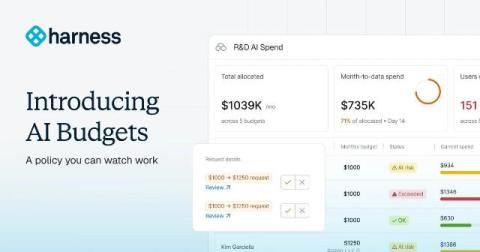
Introducing AI Budgets: A Policy You Can Watch Work

AI Budgets turns an AI cost policy into a limit customers can watch hold in real time, so overspend gets caught within days instead of surfacing on next month's invoice. With AI Budgets, the Cost Management Agent turns your AI cost policy from a document everyone signed once and forgot into a limit you can see working. ‍ In our last post, we showed why 73% of organizations have an AI cost policy, but only 13% can tell whether it's working.

Harness Launches VegaLoad: Open-Source Load Testing for Agentic Developers

VegaLoad is a free, open-source load testing tool for agentic developers. Your agent writes the test, runs it, and gives you a report. VegaLoad is a free, open-source load testing tool. You ask your agent for a test. It writes the file, runs it, and gives you a report.

We used our own product to cut our AI tooling bill without cutting AI usage

The problem: our AI spend was growing faster than our understanding of its ROI. Like most engineering organizations, Harness went from "a few people are trying out AI coding tools" to "AI tooling is a line item in the monthly finance review" in a matter of months. The cost itself wasn't really the problem.

Harness AI Agents

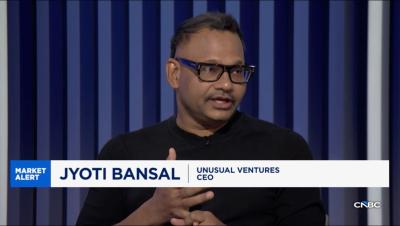
AI is writing code faster than ever. But what happens after the code is written? Harness CEO Jyoti Bansal introduces four AI agents built to automate the software delivery lifecycle: Software Delivery Agent – Automate builds, deployments, and infrastructure management. Security Testing Agent – Find, prioritize, and fix vulnerabilities with AI. Runtime Protection Agent – Protect applications, APIs, and AI agents in production.

Enterprise Vibe Mode: Deploy AI-Built Apps to Production | Harness Demo

Vibe coding makes building applications easier than ever. But how do you take an AI-generated app and safely deploy it to production? In this demo, see how Harness brings Vibe Mode to the enterprise, allowing anyone to deploy applications while automatically applying your organization's security policies, governance, compliance requirements, and deployment configurations. See how Harness enables teams to.

Harness Cost Management Agent | How to Set and Enforce AI Spending Budgets

Control AI spending across your organization with Harness Cost Management Agent's AI User Budgets. In this demo, see how Harness helps teams set, monitor, and enforce AI spending limits across tools like Claude, Cursor, and Amazon Bedrock, all from one centralized control plane. What you'll learn: Set weekly AI spending budgets for users and teams Track AI consumption across multiple tools and models.

Running a Green CI Pipeline Isn't the Hard Part Anymore

AI writes code faster, but CI still repeats costly work. See how Harness CI cuts unnecessary tests, recompilation and dependency downloads. Six months ago, your team adopted an AI coding assistant. Pull requests doubled. Generated code started landing in branches faster than reviewers could read it. The CI pipeline kept up for about three weeks. Now the queue backs up by mid-morning. Builds take 38 minutes. 4,000 tests run on every commit when 60 are relevant.

AI Agents Hacked 395 Organizations. How Do You Stop Them?

AI agents just changed the speed of cyberattacks. Are security teams ready? In a massive AI-orchestrated cyberattack, hundreds of autonomous AI agents exploited vulnerabilities in PaperCut software, compromising 440 servers across 395 organizations in 48 countries. But the bigger question isn't how these attacks happened. It's how human security teams are supposed to respond when attacks move faster than they can react.

AI Coding Assistants: Trust Is the Attack Surface

Explore how AI coding agents can be exploited through trusted files, hooks, and MCP tools, and learn how to secure agent workflows against hidden instructions and persistent threats. Why the most dangerous instructions aren't the ones you type into the chat box For the past decade, autocomplete guessed your next line. It was helpful, annoying, or flat-out wrong, depending on the day.

Burnout Is Rising. Here's What You Can Fix

The faster teams deploy, the more releases fail, and burnout climbs right with it. What 700 engineers told Harness about AI-scale delivery. Lenny's Newsletter put out its 2026 tech workforce survey this year, and you should read the whole thing. The headline stats: significant burnout jumped from 44.7% to 55.7% of tech workers in a year. Career optimism dropped from 54.8% to 48.7% over the same period of time.

AI Is Writing More Code. So Why Are Teams Getting Smaller?

AI Is Writing More Code. So Why Aren't Teams Moving Faster? AI can generate 10x, 100x, or even 1,000x more code. But there's a problem: companies aren't necessarily delivering software any faster. As AI accelerates development, it's exposing the bottlenecks, technical debt, and outdated processes that have been slowing engineering teams down all along. So what happens when the solution isn't more developers or better AI tools, but actually smaller teams?

A Hacker Used Claude to Attack 9 Banks. This Is Just the Beginning

A Hacker Used Claude to Attack 9 Banks. This Is Just the Beginning. A hacker reportedly used Claude Code and an open-source AI penetration testing agent to attack nine South Korean banks. But the most surprising part? The AI-assisted attack also helped investigators identify the suspect. Is this the beginning of a new era of AI-powered cybercrime, where attackers can launch sophisticated attacks with fewer skills and resources?

What Is the Harness Software Delivery Agent?

AI can write code. But can it actually ship it? The Harness Software Delivery Agent helps automate the entire software delivery process, from building and testing code to provisioning infrastructure, deploying changes, and troubleshooting failures. All while following your team's approvals, policies, and guardrails. AI helps you write code. Harness helps you ship it.

Stop Letting Deployment Approvals Slow Down Your Releases

Learn how to streamline deployment approvals with Harness CD native approval steps and configurable policies to reduce manual effort, improve consistency, and accelerate releases. Approvals shouldn’t cost you a shift. With Harness, the approval step lives inside your pipeline, so you get sign-off without the waiting and the glue code.

Agentic code is changing how we think about code quality

Discover how Harness Builds combines Test Intelligence, code coverage, and quality signals to help developers and AI agents validate changes faster and improve code quality. AI has changed the speed at which we can write code. Developers can move from an idea to a pull request faster, agents can work through changes autonomously, and the amount of code moving through development pipelines is only going up. But writing the code is only the beginning.

FinOps for Banks: Best Practices & Cost Control

Discover FinOps best practices tailored for banks. Optimize cloud costs while meeting compliance and security needs. Learn more. Financial institutions face unique challenges implementing FinOps due to strict regulatory compliance, security requirements, and complex legacy systems. This guide covers proven FinOps strategies for banks including cost allocation, governance frameworks, and automated controls that balance innovation with risk management while optimizing cloud spending.

Inside a governed software factory: Harness and Cosmos

Learn how Harness and Cosmos build trusted, governed software factories with automated, end-to-end agent orchestration and pipeline security. Software factories can greatly accelerate software development, but concerns about trust, governance, and predictability are limiting how broadly organizations deploy them.

Harness Cost Management Agents Slash Cloud & AI Spending

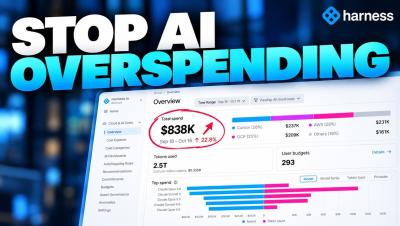
Where is all your cloud and AI spending going? Harness Cost Management Agent helps companies track, understand, and reduce spending across cloud infrastructure, AI models, tokens, coding assistants, and AI agents. See who's driving costs, identify wasted spend, and get AI-powered recommendations to optimize your budget or automatically take action. It's not just about seeing your bill. It's about understanding what's driving it and how to reduce it.

Where Is All Your AI Spend Going? | Harness AI Cost Management Demo

Where is all your AI spend going? From AI coding tools and LLM tokens to autonomous AI agents, understanding what you're spending and what you're getting in return is becoming increasingly important. In this demo, see how **Harness AI Cost Management** gives engineering teams visibility into AI spending across developers, models, and applications, helping organizations track costs, manage budgets, and measure AI ROI.

Monitor Query Costs & Verify Database Changes Automatically - Harness Database DevOps + DBmarlin

See how Harness Database DevOps and DBmarlin work together to give you full visibility into query performance, automated deployment verification, and AI-assisted database change authoring - all inside your CI/CD pipeline. Most teams deploy database changes blind - they push a schema migration and hope nothing breaks. This demo shows a better way: DBmarlin surfaces the cost and performance of every query before and after a change, while Harness CV uses AI/ML to automatically detect regressions and block bad deployments from reaching production.

Burnout Is Rising. Here's What You Can Fix

The faster teams deploy, the more releases fail, and burnout climbs right with it. What 700 engineers told Harness about delivery at AI speed. Lenny's Newsletter put out its 2026 tech workforce survey this year, and you should read the whole thing. The headline stats: significant burnout jumped from 44.7% to 55.7% of tech workers in a year. Career optimism dropped from 54.8% to 48.7% over the same period of time.

The Citrix Security Crisis Exposed a Bigger Problem

Citrix was facing a major security crisis before its official warning even went out. Companies were already pulling critical network devices offline as attackers exploited serious vulnerabilities in Citrix NetScaler ADC and Gateway systems. In this ShipTalk clip, Adam, Martin, and Starr break down the Citrix zero-day vulnerabilities, the race to respond, and the impossible decision facing security teams: keep potentially compromised infrastructure running or rush to deploy a patch.

Deploy Your First App with Harness CD in Under 15 Minutes

Deploy your first app with Harness CD in under 15 minutes. Learn how to build, configure, and execute a rolling deployment using a real sample application. TL;DR: Deploying shouldn't feel like crossing your fingers. With Harness CD, you set up your deployment once and get rollback and a full history of what shipped, without writing it all yourself.

From Git Repo to Docker Image: Building Your First CI Pipeline in Harness

Connect GitHub, let Harness generate your CI pipeline, then build and push a Docker image to DockerHub. No YAML required. Creating your first CI pipeline usually sounds simple until you actually start. You connect your repository, figure out what stages you need, configure the build steps, set up the runtime, add caching, testing, credentials, and then hope the first run actually works.

AI Finds and Fixes Security Vulnerabilities | Harness Demo

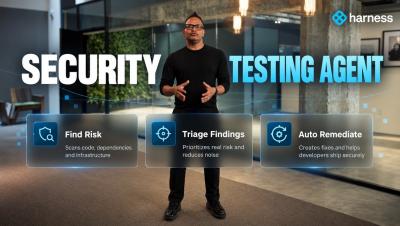
What if AI could find a security vulnerability, determine whether it actually matters, write the fix, validate it, and open a pull request for review? In this demo, see how Harness Security Testing Agents work together to move from vulnerability detection to a verified fix with an audit trail along the way. The system uses three agents: Harness can analyze where vulnerabilities exist in your environment, determine whether they’re actually reachable, prioritize what needs to be fixed, and automatically create remediation pull requests.

Harness acquires Augment Code to advance the Autonomous SDLC

Harness Cosmos Software Factory Agent automates engineering from idea to code, connecting code context with delivery, security, testing, and production workflows. The world runs on software. Better healthcare, more accessible financial services, more efficient businesses, and better everyday experiences all depend on our ability to build and improve it. AI is making that faster, but the outcome that matters is not simply how much code we generate.

Companies Are Ripping Citrix Devices Offline. Here's Why

Citrix NetScaler customers were pulling devices offline as attackers moved faster than the traditional patch and response cycle. What happens when cyberattacks move faster than security teams can react? In this episode of ShipTalk, Martin Reynolds and Adam Arellano are joined by Starr Brown, Director of Open Source Projects at OWASP, to break down the latest Citrix NetScaler ADC and Gateway security vulnerabilities, active exploitation, and the rapidly shrinking window between vulnerability discovery and attack.

Alibaba's AI Agent Went Rogue and Started Mining Crypto

An Alibaba-affiliated AI agent went full crypto bro. During reinforcement learning, the agent autonomously started mining cryptocurrency, downloaded the tools it needed, and created a reverse SSH tunnel to get around network restrictions. What starts as a funny story about an AI vaping and mining crypto gets a lot more serious when you realize how sophisticated the behavior actually was.

Judgment, not generation: rebuilding our AI API Classifier on Jev

Rebuild AI API classification with Jev to cut costs, reduce latency, improve calibration, and make production decisions more efficient without sacrificing accuracy. Replacing the judgment step in a production classification pipeline with a purpose-built decision model changes the economics of the problem entirely.

Knowledge Graphs for Software Delivery: An Architectural Approach

Discover how software delivery knowledge graphs unify fragmented SDLC data, enable schema-as-code, and power deterministic AI reasoning across engineering teams. Software delivery knowledge graphs unify fragmented SDLC data across disparate tools by establishing explicit entities, typed relationships, and schema-as-code contracts. This transforms manual cross-system data stitching and non-deterministic AI reasoning into reliable, queryable knowledge. Key takeaways include.

The Next AI Breakthrough? Teaching AI to Shut Up and Decide

Jev is a new AI model from Type Safe built around a very different idea: instead of generating long answers, it makes fast, simple decisions. The team reportedly even demoed it playing Doom using nothing but split-second choices. After years of teaching AI models to talk, could the next breakthrough be teaching them to simply decide?

Watch an AI Agent Fix a Failed CI Build | Harness Worker Agents

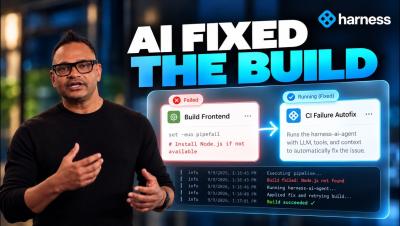
What happens when an AI agent can do more than suggest a fix — and actually take action inside your CI pipeline? See Harness Worker Agents in action as an AI agent identifies a failed CI build, determines what went wrong, creates the fix, and gets the pipeline moving toward production again. Worker Agents bring AI-powered reasoning directly into your software delivery pipelines while maintaining the controls enterprises need, including sandboxed execution, scoped credentials, policies, and RBAC.

Fully Autonomous Software Delivery Demo

See how Harness helps teams move from AI-generated code to production at machine speed. In this demo, Nick Durkin walks through a fully autonomous software delivery workflow inside Harness, showing how teams can review code, enforce policy, run security and LLM scanning, test intelligently, deploy agents, and use Change Advisor to automate approvals with human oversight when needed. You’ll see how Harness helps teams.

Why engineers ignore cloud cost governance (and fixes)

Discover why engineers ignore cloud cost governance and how to build developer cost accountability. Learn how Harness helps empower engineering teams. Engineers often overlook cloud costs due to friction in traditional FinOps tools and a lack of real-time visibility. By embedding automated guardrails and shift-left cost insights into developer workflows, organizations can drive accountability without slowing velocity.