Operations | Monitoring | ITSM | DevOps | Cloud

"Crown Jewels In, Crown Jewels Out" - The Hidden Risk of AI

How do you secure data in the age of Agentic AI? In this episode of ShipTalk, Dewan Ahmed sits down with Devan Shah, Chief Architect of Data Security at IBM, to explore the massive shift from traditional DevOps to AI-infused software delivery. Devan shares his journey from being a chef to leading an "army" of 450+ developers at IBM. They dive deep into the technical bedrock of IBM’s "OnePipeline" (built on Tekton and Argo CD), the rise of Data Security Posture Management (DSPM), and the architectural principles required to ship AI features without compromising security or compliance.

Introducing Skylar Advisor: You Need an Advisor, Not an AI Assistant

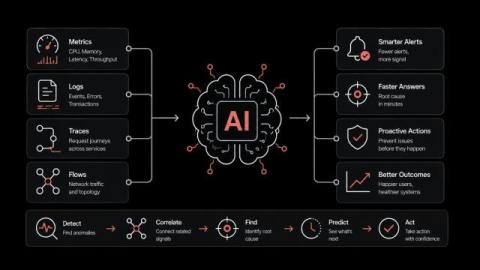
Skylar Advisor is a next-generation experience powered by Skylar AI, built to help IT teams focus on what matters right now. In this video, ScienceLogic Chief Product Officer Michael Nappi shares how Skylar Advisor proactively curates and summarizes key signals across monitoring tools, logs, and streaming telemetry into clear advisories your team can act on in seconds.

We Measured AI Impact for 12 Months. Here's What Actually Happened.

When we rolled out AI coding tools across our engineering team, the first few weeks felt great. Developers were enthusiastic. Acceptance rates looked healthy. Everyone said they felt more productive. Then my CEO asked me a simple question: “Is it working?” And I realized I didn’t have a good answer. Feeling productive and being productive are not the same thing.

Are Businesses Leaving the Cloud?

Learn the truth about cloud repatriation, the motivations behind it, and whether it’s really happening as much as you think. For years, the cloud has been the default solution for businesses wanting speed of deployment with quick and easy scalability. And while the cloud promises endless resources at your fingertips, a lot of network teams are having the conversation about whether to pull their workloads back out of the public cloud and run them on their own hardware or private cloud again.

What Companies Get Wrong About Autonomous IT, And What Actually Moves Them Forward

Many organizations approach Autonomous IT with the assumption that adding more tools, more data, or more automation will eventually produce self-governing operations. This assumption creates the illusion of progress. Complexity does not resolve itself when new systems are layered on top of existing ones. In most environments, each new tool adds another interpretation of the truth, which compounds the cognitive load on teams and forces more reconciliation, not less.

The Best Open Source Object Storage Alternatives to AWS & more

Open source cloud storage offers greater transparency and peace of mind that your data is stored safely, as the code that builds that platform is available for everybody to view and verify its security and data handling. With compatibility for popular APIs like Amazon S3, these 7 object storage solutions can handle a wide range of workloads, from backups and archives to data lakes and AI applications, while remaining scalable and cost-effective.

Kubernetes Vs. OpenStack: How They Differ, How They Work Together, And When To Use Each

Kubernetes and OpenStack are not competitors. They operate at different layers of the stack and are often used together. OpenStack manages cloud infrastructure such as compute, storage, and networking. Kubernetes runs on top of that infrastructure to deploy, scale, and manage containerized applications. Teams often compare them as alternatives, but in practice, Kubernetes frequently runs on OpenStack.

Your Cloud Economics Pulse For February 2026

Welcome to February’s Cloud Economics Pulse, CloudZero’s monthly look at cloud spend as AI moves from experiment to expectation. Last month, we closed out 2025 with a settling: provider shares locked in, compute softened, and AI claimed more of the mix (big surprise there). January confirmed those patterns weren’t year-end hustle and bustle. They signify a new baseline. Also, the Big Three (AWS, GCP, Azure) barely moved. They’re as entrenched as can be.