Operations | Monitoring | ITSM | DevOps | Cloud

Your AI coding gains are stuck before the code is even written

At some point this year, you likely approved a request to expand AI coding tool access across the team. The pitch was straightforward: engineers write code faster, the team ships more, the investment pays for itself. The first half happened. Engineers are writing code faster. If you're now being asked whether the investment paid off, and you're finding the honest answer is more complicated than a yes, you are not alone, and you have not been sold something broken.
Your users already know what's relevant. Are you listening?

TL;DR If you work on search relevance, you know the feeling. You ship a synonym. You boost a field. You add a vector model. You stare at a judgment set that was labeled six months ago and hope the next NDCG number moves in the right direction. Somewhere between offline metrics and production traffic, a quiet gap opens: you optimized for what you think users want, not for what they actually do when the results appear. That gap is not a failure of effort. It is a missing feedback loop.

How Harness orchestrates LLM security scanning

Large language models are effective at security review for the same reason they are effective at many other tasks: they reason rather than pattern match. In plain terms, a traditional scanner checks code against a list of known bad patterns, the way a spell checker flags a misspelled word, regardless of what the sentence means. An LLM can instead follow the program's logic: trace a piece of attacker-controlled input through several layers of application code to determine whether it is reachable.

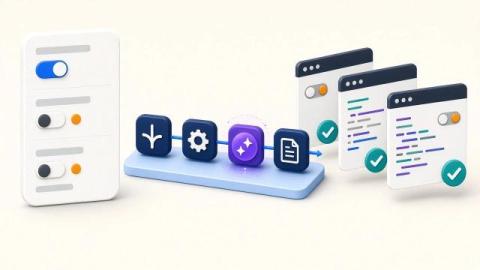
How we automated feature-flag cleanup with Agentic Pipelines

The hard part of a feature flag is rarely adding it. It is remembering to remove it months later, when the rollout is over, the original context has faded, and there is always a more urgent piece of work waiting. Since April 2026, one Atlassian team has used Agentic Pipelines to clean up their monthly backlog of stale feature flags. The workflow prepares the change and opens a pull request, while engineers still review and merge the pull request.

The Clearinghouse For AI Agents Has A Blind Spot

Jamin Ball’s recent piece, “Systems of Record Won the SaaS Era — Clearinghouses Will Win the Agents Era,” is the cleanest articulation I’ve seen of where the durable moat goes next. His argument is simple and, I think, correct: the SaaS era rewarded whoever owned the system of record, and the agent era will reward whoever owns the clearinghouse.

How to improve agent experience (AX) with CI

Improving agent experience (AX) is one thing. Keeping it good as your product changes is harder. A renamed field, different error response, or overlapping tool can turn a workflow that worked yesterday into extra retries, wasted tokens, or human intervention. CI gives teams a way to catch AX regressions as part of the development process. You can test the interfaces agents depend on, run representative agent workflows against product changes, and preserve fixed failures as regression cases.

Correlating Business and IT Events: The Path to Business Process Observability

At 9:40 on a Tuesday morning, an order sits unconfirmed in the fulfillment process. Two systems away, a queue depth ticks upward in the integration layer. Both events are recorded. Neither is connected to the other, so nobody escalates nothing is technically down. By 2 PM, order confirmations have stalled across a region. The CFO is asking why the daily revenue number looks soft. Customer service is fielding calls.

How Universities and Academic Institutions Use DCIM for Efficiency and Collaboration in Their Data Centers: 3 Real-World Success Stories

Many universities and academic institutions use data centers for a wide range of purposes: secure data storage for student and faculty information, learning management systems, and administrative operations. Universities also use data centers for research and data analysis. Research, simulations, machine learning models, and data analysis all require high-performance compute.

Monitor Third Party Services With UptimeRobot.

Your checkout might run on Stripe, your files on AWS, and your images on a CDN. When one of those providers has an incident, part of your product breaks with it, and your own monitors can stay green the whole time. Starting today, UptimeRobot monitors beyond your own infrastructure. Third party monitoring lets you add the services your product depends on, select the components you actually use, and get an alert through your existing channels when their status changes.