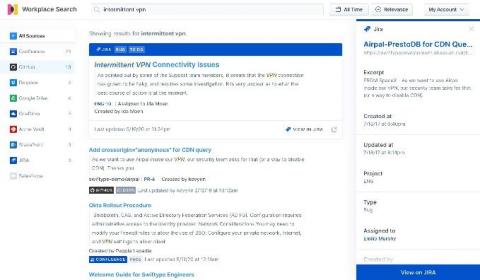
Enterprise Search- Search at Scale
A quick look into how search can transform you organization. Kellen Person - Team Lead, Workplace Search


With the increasing popularity of Python web frameworks supporting asynchronous I/O like FastAPI, Starlette, and soon in Django 3.1, there has been a growing demand for native async I/O support in the Python Elasticsearch client. Async I/O is exciting because your application can use system resources efficiently compared to a traditional multi-threaded application, which leads to better performance on I/O-heavy workloads, like when serving a web application.
We recently announced that Elastic Enterprise Search — our combined solution of search products — is now available to deploy as a single solution on Elastic Cloud. While Elastic App Search has been available on Elastic Cloud since early 2020, this is a new and exciting deployment option for Elastic Workplace Search.
Elasticsearch powers search experiences for so many tools and apps used today, from operational analytics dashboards to maps showing the closest restaurants with patios so you can get out of the house. And in all of those implementations, the connection between application and cluster is made via an Elasticsearch client. Optimizing the connection between the client and the Elasticsearch cluster is extremely important for the end user’s experience.
We’re pleased to introduce you to the latest Elastic Cloud features and functionality. Grab a cup of your favorite beverage and five minutes, and let’s dive in.
You’ve created the perfect design for your indices and they are happily churning along. However, in the future, you may need to reconsider your initial design. Maybe you want to improve performance, change sharding settings, adjust for growth. Whatever the reason, Elasticsearch is flexible and allows you to change index settings to improve your Elasticsearch Performance Tuning. Let’s see how to do that!
We're excited to announce that Elastic Enterprise Search is now available on Elastic Cloud. Simply sign up for a free Elastic Cloud account and you can be up and running in a matter of minutes. The Elastic Enterprise Search solution encompasses both our Workplace Search and App Search products — a comprehensive package of search tools that dramatically simplifies the process of creating enterprise-grade search experiences for consumers, users, and teammates alike.
Amazon Web Services Elasticsearch Service enables an organization to deploy, secure, and run their Elasticsearch clusters. AWS Elasticsearch is a cost-effective way to operate at scale. In this article, we will cover.
Jira has long been a popular issue tracking tool for development teams, but its scope has broadened quite a bit over the years, and it has bloomed into a more well-rounded project management tool as well. It’s used widely by agile teams to plan, track, and release software, along with numerous other cloud (and traditional self-managed) productivity tools.
Elastic is prepping for Elasticsearch 8.0, but in the meantime is rolling out upgrades and features with Elasticsearch 7.7. The new version introduces asynchronous search as well as changes with Elasticsearch clusters, mapping, SQL enhancements, snapshots and machine learning. This post will cover just a few of the highlights of the new release. Besides asynchronous search, ES 7.7 also introduces multi-class classification, reduced heap usage, inference time features, and better password security.