Operations | Monitoring | ITSM | DevOps | Cloud

How Facilities Management Supports Business Continuity and IT Resilience

When organizations build business continuity plans, they usually focus on software backups and cyber threats, while ignoring the physical building itself. But a single power fluctuation, HVAC failure, or roof leak can shut down critical IT assets just as fast as a digital attack. Facilities management bridges the gap between physical infrastructure and digital uptime. This guide breaks down how proactive building systems protect your technology, minimize expensive operational disruptions, and turn theoretical recovery plans into daily operational defense.

6 Websites That Make Learning Outdoor Hobbies Easier

Starting an outdoor hobby can be exciting, but the learning curve isn't always obvious from the beginning. Whether you're interested in fishing, hiking, camping, gardening, birdwatching, or spending more time on the water, there are usually dozens of small things to learn before you feel confident. What equipment do you actually need? Which beginner mistakes should you avoid? How do weather and location affect the activity? And which skills are worth learning first?

Reliability Engineering in the AI Era

Engineering leaders have been claiming to “shift quality left” for years but production remains stubbornly stuck out of reach of software engineers. The realm of production remains mysterious with tools no one has access to and UIs that wouldn’t make sense to engineers anyway. I’ve noticed a small but growing trend of large enterprises hiring Reliability Engineers instead of Site Reliability Engineers. Dropping one word looks cosmetic but I think it points to a much bigger change.

From Telemetry to Traffic

A metric says latency increased. A log says a request failed. A trace identifies the slow dependency. An APM agent points to the method. Manual instrumentation explains the business operation. Traffic capture shows the exact request and response that triggered it. Each layer answers a question the previous layer could not. Each also introduces a new cost, blind spot, and failure mode.

Shipped: A changelog that keeps up with how fast we ship

When the changelog doesn’t keep pace with the product, two things can happen. One, you keep working around something that was already fixed weeks ago. Or two, a behavior changes, you assume it’s a bug, and you spend an afternoon on triage and a support ticket before learning it was an intentional improvement. CloudZero now ships around 30 improvements a week, a pace driven by the Next Gen Platform and the AI-first approach we’re building for our customers.

Token budgets: capping AI agent and LLM spend

AI costs are changing. As noted by research from EY, outputs that cost just $0.04 in 2023 now cost $1.20, a 30x increase over just three years. It’s worth noting that task operations and complexity have also changed. In 2023, the process was simple. Users input a question, retrieval engines found relevant data, and AI models returned a response. Today, many tasks are handled by orchestrated AI agents capable of much more complex reasoning and analysis.

7 lessons for IT leaders on using observability to monitor AI applications

What it takes to prove AI value with LLM observability Over six months, the Elastic IT team ran internal AI applications that returned $2.5 million in operational time to the business.1 A conversational support assistant moved us from zero digital resolution, where anything complex became a ticket, to 30% of support interactions closing without one.

The infrastructure work you should not have to touch just to ship a feature

You wrote the feature. It works locally. Then you spend the next two hours on things that have nothing to do with the feature: a Terraform plan that wants to replace a database you didn't touch, a Kubernetes manifest that needs a new ingress rule, an IAM policy that's one permission short of what the deploy needs. None of this is the job. All of it is the job today. Here's what that list actually looks like, and why none of it should be sitting on your plate.

Trust you can verify: security assurance for the AI era

When you choose a cloud platform, you're entrusting a provider with sensitive business information, customer data, critical applications, and a growing share of your operational resilience. Increasingly, you are also entrusting it with AI. And that changes the questions you should be asking. Marketing claims cannot answer these questions. Independent evidence can. Here is what that evidence looks like at Upsun and why it matters to your next supplier review.

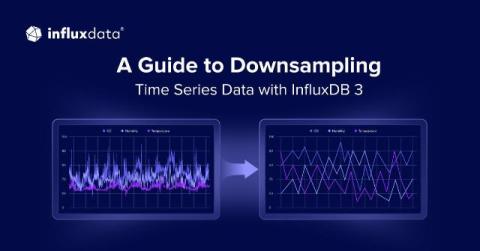
A Guide to Downsampling Time Series Data with InfluxDB 3

Summary Downsampling turns high-frequency time series data into lower-resolution summaries. In InfluxDB 3, you can calculate those summaries by querying with SQL or materialize them on a schedule with the Python Processing Engine. Table of Contents This tutorial demonstrates both approaches using the InfluxDB 3 Processing Engine’s built-in bird tracking simulator plugin. You will generate telemetry, aggregate it into 10-second windows, and validate the result with SQL.