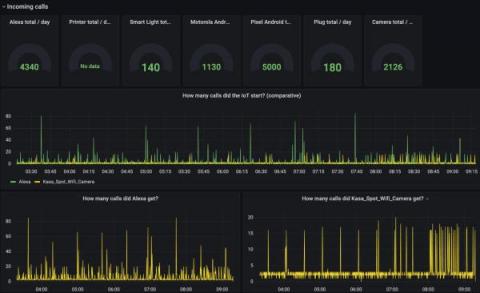
As the number of connected gadgets in our homes, offices, and industrial networks continues to grow exponentially, keeping IoT devices secure has become a vital part of our everyday lives. However, our webcams, printers, and smart plugs often lack security features due to their fast time to market, making them particularly vulnerable to attack. And because security metrics themselves can be tricky to assess, tracking IoT device security is increasingly a challenge.
In the tech industry, we obsess over the latest and greatest. When it comes to observability, we’re always looking at the most advanced hardware, the enthusiasts’ favorite systems, and the tech venture capital trends to get an idea of what to build for next. observIQ is no exception.
The MSIX orb is the first “Windows-only” orb from CircleCI. When Microsoft approached us with the opportunity to build an orb that would help Windows developers build on our platform, we were enthusiastic. Most of our orbs, and general workload, revolve around Linux and utilize Bash. However, we recognized the deep need to provide good CI/CD solutions for building applications on Windows, and with use of PowerShell growing steadily within Linux, it was time to take the plunge.
Imagine there’s an embedded system that needs to persist some state when the processor restarts (either intentionally or due to a catastrophic error). This could be some external hardware information (what’s the position of a motor or actuator?) or a method to communicate the reset to the user (display some information on the device’s display). A simple way to store information through a reboot is to use what’s called“non-initialized” memory.
A single Kubernetes cluster expends a small percentage of its total available assigned resources on delivering in-cluster networking. We don’t have to be satisfied with this, though—achieving the lowest possible overhead can provide significant cost savings and performance improvements if you are running network-intensive workloads.
Cribl released LogStream Cloud to the world in the Spring of 2021, making it easier than ever to stand up a functional o11y pipeline. The service is free for up to 1TB per day and can be upgraded to unlock all the features and support with paid plans starting at $0.17 per GB so you pay for only exactly what you use. In this blog post, we’ll go over how to quickly get data flowing into LogStream Cloud from a few common log sources.
Slow applications don’t make the season any brighter. For many IT pros, it’s a time of war rooms and swarming. How are you going to sleep this holiday season? “It sems that when people have a less-than-favorable online experience, they fault the company immediately.