Operations | Monitoring | ITSM | DevOps | Cloud

The latest News and Information on Cost Management and related technologies.

Perplexity pricing in 2026: Free vs. Pro vs. Max, and who should pay

Perplexity pricing runs $0 for Free, $20 a month for Pro, and $200 a month for Max, with enterprise seats listed from $40 per user. Pro fits most people who search for work daily. Max exists for heavy automation. The prices are verified against Perplexity's live plans page as of September 2026. When Perplexity published a customer quote on its own pricing page, it chose an unusual one.

Kling AI pricing in 2026: plans, credit costs, API packages, and the spend no invoice shows

Kling AI pricing runs from a free tier of 66 daily credits to a reported $180 per month, with annual billing about 34% cheaper. Kling 3.0 bills per second: 6 to 12 credits for standard resolutions and 30 for native 4K. The API sells separate prepaid packages from $9.80 to $7,560.

ElevenLabs pricing in 2026: plans, credits, and agent costs

ElevenLabs pricing runs from a free plan to $990 per month across six published tiers, with custom Enterprise above that. Plans meter usage in credits, where one credit roughly equals one character of speech. Voice agents cost $0.08 per minute on every tier, plus separate LLM and telephony charges. The AI agency PxlPeak published its own ElevenLabs invoice: $303 for January 2026, covering voice content for six clients, IVR systems for two, and live voice agents for three.

Token-based pricing: how AI usage billing works (2026)

Token-based pricing charges for AI by the volume of text a model processes, metered separately for input tokens (what you send) and output tokens (what the model returns). As of 2026, OpenAI, Anthropic, and Google all bill their APIs this way, and the model is spreading into enterprise chat products. Bills scale with usage rather than seats.

Manage Cursor costs with Datadog Cloud Cost Management

AI coding tools such as Cursor are becoming a significant source of engineering spend. But Cursor costs can be difficult for FinOps teams to manage. Cursor’s usage data alone doesn’t tell you how costs break down across users and models, and fixed-threshold alerts may not catch an unusual cost spike if spend remains below the threshold. Datadog Cloud Cost Management (CCM) brings Cursor costs into the same place where you monitor cloud, SaaS, and other AI spend.

150+ AI statistics for 2026: spend, cost, and AI ROI

Worldwide AI spending will reach $2.59 trillion in 2026, up 47% from 2025, according to Gartner. Yet only 37% of organizations report any earnings impact from AI, McKinsey finds. These AI statistics cover what companies spend, what AI costs to run, and the ROI they're actually getting. That gap between the two headline numbers is the story of AI in 2026.

From a $60K invoice to a $200B earnings call, few can explain the AI bill

CloudZero’s own AI Economics Pulse for September found the 75th percentile of its 430-company customer panel crossed 10% of its cloud bill on AI for the first time in August. Gartner’s latest survey found only 22% of organizations have scaled AI successfully and 11% don’t know what their own function spent on it last year. CJ Gustafson showed what that gap looks like on an actual invoice this week.

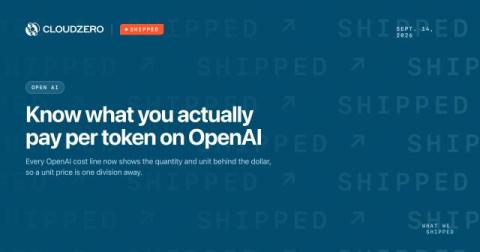
Shipped: Know what you actually pay per token on OpenAI

Picture two teams running the same million input tokens through the same model. One team’s tokens are cache hits, queued through the batch API. The other team’s are fresh, sent live. On a current-generation OpenAI model, cached input runs about a tenth the price of a fresh token, and batch processing cuts whatever’s left in half. Stack the two: at a list rate of $2 per million tokens, one team’s bill comes to 10 cents, the other’s to two dollars.