Getting up and running with Calico on AKS
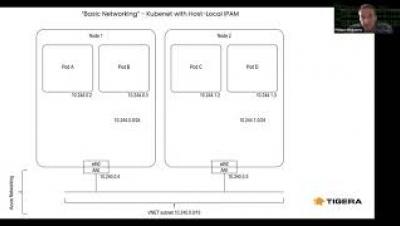
In this session we’ll review networking options compatible with Calico for AKS cluster and will build a few AKS clusters using Azure CLI and ARM template.


The latest News and Information on Containers, Kubernetes, Docker and related technologies.
In an era where container technologies have taken the industry by storm, one of the most common online searches on the topic of containers is ‘Kubernetes vs Docker’. The relevance and accuracy of this comparison is questionable, as it is not really comparing apples to apples. In this blog post, we will attempt to clarify both terms, present their commonalities and differences, and help users better navigate the ever-growing container ecosystem.
As a network of microservices changes and grows, the interactions between them can be difficult to manage and understand. That’s why it’s handy to have a service mesh as a separate infrastructure layer. A service mesh is an approach to solving microservices at scale. It handles routing and terminating traffic, monitoring and tracing, service delivery and routing, load balancing, circuit breaking and mutual authentication.
In today’s economy, digital assets (applications, data, and processes) determine business success. Cloud-native applications are designed to iterate rapidly, creating rapid time-to-value for businesses. Organizations that are able to rapidly build and deploy their applications have significant competitive advantage.
KubeCon + CloudNativeCon Europe 2020 Virtual happened online, August 18-20. It was the first virtual KubeCon, due to the coronavirus pandemic. I was happy to attend, although this was the second straight virtual conference I’ve participated in that ran on Amsterdam time. I did make it up for the 4 AM Pacific time start, though, and I was ready to go. As I got settled in, in front of my laptop, I knew I would be missing the hallway track a lot.
So you’ve got a shiny new Kubernetes cluster up and it’s a dream. Deploying code is easy, scaling is a breeze, and you’ve never felt so efficient. However, despite claims that Kubernetes is self-healing, there’s still a nagging feeling in the back of your mind that wants to make sure your cluster is running smoothly. Just like any other tool, you need a monitoring solution to give you insight into Kubernetes.
Organizations are turning in droves to Prometheus to monitor their container and microservice estates, but larger companies often run headlong into a wall: They face scaling challenges when they move beyond a handful of apps.